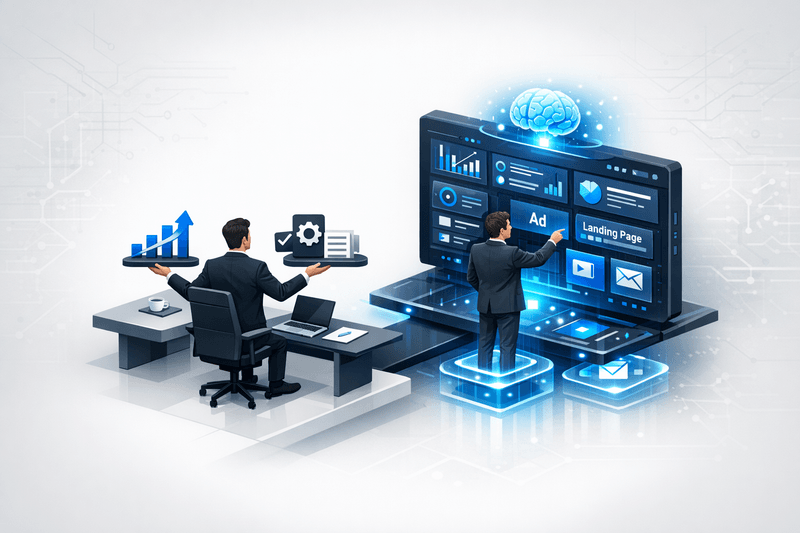
Many founders and owners of small and mid-sized businesses are stuck in a bind: without visible online marketing you don't get leads; without focus on product and operations you don't have a healthy business. This article explains why this dilemma gets even sharper in the age of AI search - and how a lean, automated marketing system can practically resolve the conflict of "growth vs. focus."
Key insights at a glance
- Almost half of all small businesses handle their marketing entirely on their own - with no team behind them.(localiq.com)
- Around half of SMEs don't have a single employee dedicated solely to marketing; many operate with marketing budgets below 1,000 US dollars per month.(ppc.land)
- 59% of small businesses cite lead generation as their biggest challenge, while around 83% still rely heavily on referrals - a fragile foundation for predictable growth.(ppc.land)
- Google's AI Overviews already appear for about 30% of desktop searches; once they show up, even the #1 organic ranking loses roughly one third of its clicks on average.(seoclarity.net)
- Studies estimate that around 60% of AI-mediated searches end without a click to any website - the answer stays stuck in the AI layer.(lemonde.fr)
- Companies with larger marketing teams are far more likely to be convinced that their marketing ROI is positive than companies without dedicated marketing resources - a clear sign of how powerful systematic marketing can be. SMEs without a team therefore need processes and automation instead of ad-hoc actions.(simpletexting.com)
Insight 1: Why founder-led marketing is almost always inconsistent
Spot the pattern: Marketing only happens when it hurts
If you run a small or mid-sized business, you'll recognize the pattern:
- In quiet phases you write a few blog posts, revise landing pages, maybe even launch a Google Ads campaign.
- As soon as projects, product development or hiring ramp up, marketing drops down the priority list again.
- Three months later you realize your inbound funnel is drying up - and you're back to square one.
This is not an individual failure; it's structural: recent studies show that almost half of small businesses handle marketing entirely on their own - usually by the owner.(localiq.com) At the same time, around 50% of SMEs have no one whose sole focus is marketing; budgets are often under 1,000 US dollars per month.(ppc.land)
In other words: you're expected to run product, team, sales and operations - and on the side manage a full program of online marketing, content creation, campaign management and reporting.
What that means for your lead pipeline
This reality has clear implications for your lead generation:
Lead spikes instead of a stable pipeline
Many SMEs experience marketing in waves: after intense phases with new landing pages, blog posts and email campaigns, leads go up - only to drop again a few months later when day-to-day operations take over.Over-reliance on referrals
In surveys, 59% of small businesses name lead generation as their biggest challenge; at the same time, 83% rely primarily on referrals, especially companies with up to ten employees.(ppc.land) Referral business is valuable, but not scalable enough to reliably hit growth targets.Content sprawl without a system
Without a clear content strategy you end up with isolated blog posts, product descriptions or comparison pages that don't build on each other. Keyword clusters aren't planned deliberately, landing pages exist without a clear connection to campaigns or AI search - and every new campaign feels like a fresh start.Dependence on you as a person
If you as the founder are the only one briefing campaigns, approving landing pages and correcting blog posts, then your entire inbound marketing hinges on your available time. When that time goes away, so does the marketing.
The consequence: growth remains reactive. You respond to gaps in your order book instead of building a reliable inbound funnel that keeps running even when you're busy putting out fires in product or sales.
Insight 2: The rules have changed - from classic SEO to AI search
Plan content for Google, ChatGPT & Co. at the same time
The equation used to be simple: you optimize your website for Google, use SEO tools, write blog posts and landing pages for specific keywords - and hope for rankings.
Today there is increasingly an AI layer between user and website:
- Google AI Overviews aggregate answers directly in the search results - above the organic listings.
- ChatGPT, Gemini, Perplexity & Co. answer questions without users even opening a browser tab with your website.
- More and more users ask these systems directly for "the best tools for...", "providers in my region for..." or "alternatives to [product X]".
Analyses show that Google's AI Overviews are now displayed for about 30% of desktop search queries - and that share is growing fast.(seoclarity.net) When an AI Overview appears, even the top organic result loses around one third of its clicks on average; many users read the summary and don't click any source at all.(ahrefs.com) Estimates suggest that roughly 60% of AI-mediated searches end without a website visit.(lemonde.fr)
For you this means: it's no longer enough to "just" show up in traditional organic search results. Your company has to be described in a way that AI systems can understand you, trust you - and mention you in their answers.
Implication: you need structured, recognizable answers
AI search doesn't work exactly like a classic ranking algorithm, but it relies on similar signals:
- Clearly structured content: landing pages, FAQs, comparison pages and blog posts that cleanly answer concrete questions - not just marketing slogans.
- Consistent content across many touchpoints: when AI models repeatedly encounter the same clearly explained value props, product data and use cases, the likelihood they see you as a relevant source increases.
- Broad coverage of your audience's questions: instead of maintaining one big "About us" text, you need a web of topic pages - from use-case landing pages to product descriptions through to comparison pages ("X vs. Y") and in-depth blog articles.
For SMEs this means a shift:
- Away from sporadic one-off actions in digital marketing.
- Towards continuous content creation and publishing across landing pages, blog posts, FAQs, Google Ads and more - with a focus on AI search and traditional search.
This is exactly where the founder's dilemma bites hardest: you need more and better structured content - but your available time isn't increasing.
Insight 3: A classic marketing team is unrealistic for many SMEs - doing nothing is still not an option
Accept your constraints: budget, people, time
Most SMEs will never build a ten-person marketing team - and they don't have to. But the numbers show why "no system at all" is risky:
- Studies report that around 52% of small businesses have marketing budgets under 1,000 US dollars per month.(ppc.land)
- About half have no dedicated marketing staff; marketing happens "on the side" via the owner or sales.(ppc.land)
- Lead generation is mentioned far more often as the biggest challenge than, say, branding or social media.(ppc.land)
- Companies with larger marketing teams are much more likely to be confident their marketing ROI is positive - a sign of how much systematic funnel work pays off.(simpletexting.com)
For you this means:
- It's normal that you can't hire 3-5 marketers.
- It's still dangerous to treat marketing as purely opportunistic.
You need a third option between "do everything yourself" and "build an expensive full-service team or agency setup."
Solution: a marketing OS instead of more headcount
This is where AI marketing comes in - not as a "magic text machine," but as a marketing operating system for lean teams.
Nukipa is built exactly this way: you can think of it as an AI marketing desk for SMEs that runs your content production and campaigns end-to-end:
- Inputs: your website, existing decks, product sheets, positioning docs, notes, compliance guidance.
- Outputs: landing pages, blog posts, product and service descriptions, comparison pages, FAQs, keyword clusters, Google Ads copy - and shortly, ongoing campaign management on top.
- Loop: measure which content shows up in Google & AI search, which pages generate leads, which campaigns resonate - and based on that, generate new content or improve what's already live.
Important here:
- Human-in-the-loop remains non-negotiable. All AI-generated content should be reviewed by a qualified person before publishing - for expertise, legal aspects and tone.
- Your expertise is the raw material. A good AI marketing system doesn't replace your know-how; it turns that know-how into scalable online content - in multiple languages if you want.
Instead of building your own content team, you work with a "marketing team in a tab" that drafts, structures and prepares landing pages, blog posts, ads and more for publishing 24/7 - steered by you or a single person in your team.
Insight 4: How to resolve the growth-vs.-focus dilemma operationally
Build a simple marketing loop that runs weekly
To get out of the "growth vs. focus" trap, you don't need a 50-page marketing plan, but a lean, repeatable loop. One possible blueprint for an SME with Nukipa as its marketing OS could look like this:
Sharpen positioning & goals (once + every six months)
- Define 3-5 core offers.
- Set target markets and languages (e.g. DACH + English).
- Set clear goals: e.g. "10 qualified demo requests per month from inbound."
Create a content backlog (initial sprint phase, 1-2 weeks)
- One clear landing page per offer.
- 5-10 blog posts on typical customer questions.
- Comparison pages ("Alternative to...", "[your product] vs. [competitor]").
- FAQ blocks and product descriptions suited to AI search and traditional search.
- Initial keyword clusters and topic areas that systematically cover your offering.
Feed the AI marketing desk
- Upload website URL, sales decks, product sheets.
- Define must-have and no-go statements (compliance, claims, voice & tone).
- Set languages and priorities for content localization.
Weekly production slot (60-90 minutes)
- Review, adjust and approve 1-2 new landing pages or blog posts.
- Review Google Ads suggestions, fine-tune budgets and keywords.
- Check reports: which pages perform, which search queries (keywords and AI prompts) show up, where are the gaps?
Improve instead of reinvent
- Expand strong pages with additional FAQs, use cases or local variants (content lifecycle).
- Use AI agents to rework weaker pages: better structure, clearer value props, more relevant keywords.
- For agencies: apply the same loop as a white-label process across multiple client accounts.
This shifts your role as founder from "solo operator writing blog posts" to editor-in-chief who steers the system - with clear visibility into pipeline, AI search visibility and campaign performance.
Concrete everyday scenarios
Three short examples of what this loop can look like in practice:
B2B SaaS with 12 employees
The founder currently spends every other Friday creating content. With an AI marketing desk like Nukipa she defines her positioning and core use cases once. After that she reviews new feature landing pages, comparison pages and blog posts on typical buyer questions each week, while Nukipa simultaneously tracks Google Ads and AI search visibility. Actual "founder time" drops to 60 minutes per week - with higher output quality at the same time.Technical mid-sized manufacturer with strong sales
Sales thrives on existing customers and trade shows; new leads are slow. Data sheets and certifications are turned into structured product pages, application guides and industry-specific landing pages in several languages. Engineers and sales leadership now only approve content and add details instead of writing everything from scratch.Consulting firm with local focus
The owner wants to be seen as the go-to expert in her region when people ask ChatGPT or Google for help. An AI marketing desk produces local landing pages, blog posts with real-world examples and FAQs on common client questions. Visibility in AI search rises, and the website becomes a clear extension of personal referrals.
In all three cases, the founder's dilemma turns into a clear process: growth through continuous, automated online marketing - with minimal loss of focus in day-to-day operations.
Conclusion and next steps: from ad-hoc marketing to a running system
The core message of this article:
- The "growth vs. focus" dilemma arises because SMEs treat marketing as a project, not as a system.
- AI search increases the pressure to continuously publish relevant, structured content - otherwise companies disappear between AI overviews and generic answers.
- A classic marketing team isn't realistic for many SMEs. An AI marketing desk / marketing OS can fill that gap by taking over content creation, content publishing and campaign iteration - with you as the human quality and strategy owner.
Concrete next steps for you:
Status check
Answer honestly for yourself: who is doing your online marketing today? How many new landing pages, blog posts or campaigns have you published in the last 90 days?Collect questions
Write down 20 questions your best customers regularly ask - in sales conversations, at trade shows or via email. This is the basis for blog posts, FAQs, comparison pages and landing pages.Create a content plan in 60 minutes
Cluster these questions into 3-5 topic groups and define per group:- 1 central landing page
- 3-5 blog posts
- 1 comparison page or case study
- 5-10 keywords or search phrases you want to target
Test an AI marketing desk
Use a system like Nukipa to turn this plan into real, publish-ready content within a few days - in German and, if relevant, additional languages. Important: review remains with you or your team.Block a weekly marketing slot
Set a fixed weekly time slot (e.g. Tuesday 9-10 a.m.) where you only:- approve new content,
- review reports on leads and Google & AI search visibility,
- set the next priorities in your content backlog.
This way you turn the founder's dilemma into a design question instead of a permanent conflict: how do you set up your marketing system so that growth becomes possible without losing focus on product and operations?
Nukipa supports you exactly here: as an AI marketing desk for SMEs that plans, writes, publishes and iteratively improves landing pages, blog posts and Google Ads - so you get inbound without building your own marketing team or constantly managing agencies.
Frequently asked questions (FAQ)
1. We live mainly off referrals - do we even need online marketing?
Referrals are a strong foundation, but they rarely scale linearly with your growth goals. And even referred prospects now go online to validate you: they google your company name, ask ChatGPT for alternatives or look for reviews.
Without a solid online presence - landing pages, clear product descriptions, recent blog posts, straightforward FAQs - you risk good referrals failing because your digital presence is weak. Online marketing doesn't replace referrals; it amplifies them.
2. How is AI marketing different from classic SEO tools?
Classic SEO tools mainly help you measure and analyze: rankings, backlinks, keyword opportunities. They show you what is - but they don't create and publish content for you.
An AI marketing desk like Nukipa combines analysis and execution:
- It structures your expertise so that it can automatically generate landing pages, blog posts, comparison pages, FAQs and Google Ads.
- It continuously publishes and updates this content (content publishing and blog automation).
- It tracks where you are visible in Google and AI search and, based on that, suggests new content or optimizations.
So you don't just get data; you get fully produced assets - a crucial difference for lean teams.
3. Isn't AI-generated content generic or even wrong?
Yes, if you simply ask a generic AI with no context to "write a blog post about online marketing," the result will be interchangeable and in the worst case incorrect.
The quality of AI content depends on three factors:
- Your input: the better you provide your positioning, target audiences and examples, the more precisely the system can work.
- The system's structure: a specialized AI marketing OS is designed to understand your material, structure it cleanly and prepare it for AI search and classic search - instead of just producing "pretty sentences."
- Human review: at Nukipa, one simple rule applies: all AI-generated content is reviewed by a qualified person before publishing. Subject matter accuracy, tone, legal aspects - that remains your responsibility.
With this setup, "AI text" doesn't turn into random content, but into a scalable channel to make your real expertise visible.
4. Does a solution like Nukipa replace our agency or in-house marketing team?
Not necessarily - often it simply shifts how work is divided.
- For SMEs without a team: an AI marketing desk can take over large parts of the operational work - content creation, content publishing, basic campaigns. You then mostly need someone to make decisions and approve content, not a full-fledged marketing team.
- For companies with a small team: your marketers can focus on strategy, creative concepts and deeper campaign experiments, while routine tasks (blog posts, landing page variants, ad copy iterations) are automated.
- For agencies: AI marketing platforms can often be used as white-label solutions. That way you increase output per client without growing your team - and offer modern services around AI search and content automation.
The goal isn't to replace people, but to focus their time on the tasks where they make the biggest difference - and let a reliable marketing operating system handle the rest.