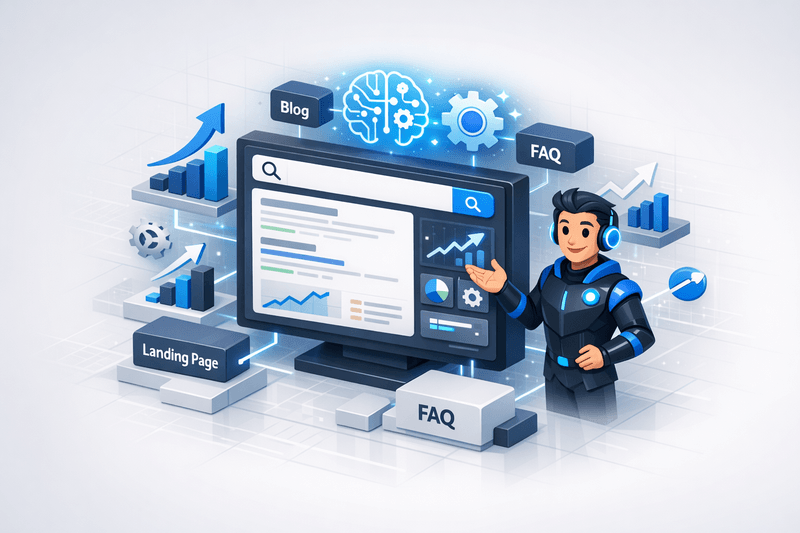
Search is changing fast: people are asking their questions more and more often in AI-powered tools like Google AI Overviews, ChatGPT, or Perplexity-and expect clear answers immediately. For SMEs, this means: classic SEO alone is no longer enough. You need content that convinces both humans and AI agents.
This guide walks you step by step through how to set up your online marketing, landing pages, blog posts, and Google Ads so your company becomes visible in AI search-and how to turn that into measurable lead generation and customer acquisition.
What You Really Need for AI Search Optimization
Before you start, do a quick check that the basics are in place. You don't need a big marketing department or complex SEO tools-but a few prerequisites help a lot:
Clear focus on your target customers
Who are your ideal customers (industries, roles, regions) and which problems do you solve specifically?A website you can extend
Ideally a CMS (e.g. WordPress, HubSpot, Webflow) where you can create landing pages, blog posts, comparison pages, FAQs, and product descriptions without a developer.Simple measurability
At least one contact form or quote request, plus web analytics (e.g. Google Analytics, Matomo) and access to your Search Console.2-4 hours per week
For review, approvals, and prioritization. The actual content creation can be increasingly automated.A lean AI marketing platform (optional but strongly recommended)
With a solution like Nukipa-the AI marketing desk for SMEs-you can automatically create, publish, and continuously optimize landing pages, blog posts, comparison pages, FAQs, and Google Ads, including tracking your visibility in AI search. This keeps you moving fast without a large team or agency management.
Step by Step: 6 Stages to AI-Search-Optimized Marketing
Step 1: Understand How AI Search Works Today
What you should do
Get an overview of how AI search presents results-specifically:
- Search in Google for typical informational questions your customers ask and see whether an AI Overview appears.
- Ask the same questions in ChatGPT, Perplexity, or Microsoft Copilot and observe which websites are linked as sources.
Why this step matters
Google AI Overviews and other answer engines generate answers on their own from web content and structured data and often push classic results far down the page. In particular, informational queries (e.g. "best marketing strategies for small businesses") trigger these overviews, whereas transactional or purely local searches are still more heavily dominated by ads and Maps.(seobility.net) Studies also show that around 60% of Google searches already end without a click to a website-people find what they need directly on the results page.(seobility.net) For your inbound marketing, this means: your content needs to make it into the AI answers, not just "rank on page 1."
At the same time, tests show that AI-powered search engines still often provide inaccurate or incorrect answers.(techradar.com) The clearer and more credible your content, the more likely it is to be cited correctly-and the more control you keep over your digital presence.
Common mistakes
- Only looking at classic rankings and individual keywords without checking AI answers.
- Assuming that AI search works "magically" and you can't influence it.
- Leaving incorrect or outdated content on your own site-AI systems will still use it.
Step 2: Think of Customer Questions as Prompts
What you should do
Consciously switch into your target customers' perspective. Instead of just wanting to "find keywords", collect questions and prompts:
- List 20-30 real questions customers ask you-from sales calls, support, trade shows, emails.
Examples:- "Which ERP system is suitable for manufacturers with 50-200 employees?"
- "Which online marketing activities actually generate leads for a regional trade business?"
- "Alternative to [competitor] for [use case] in [region]?"
- Phrase these questions the way a person would type them into ChatGPT or Google-naturally, with context and sometimes with location.
- Sort the prompts by funnel stage: understand the problem -> compare solutions -> choose a provider.
This gives you your first prompt backlog-the foundation for your content strategy, content plan, and later keyword clusters.
Why this step matters
AI search thinks in questions, context, and intent, not in single keywords. The technical term is Answer Engine Optimization (AEO): optimizing to deliver a complete, helpful answer instead of just matching a keyword.(en.wikipedia.org) This is exactly where you start when you plan your content around real prompts.
Common mistakes
- Only collecting short-head keywords ("online marketing agency", "CRM software").
- Using internal jargon ("360-degree customer platform") that no one actually searches for.
- Not clustering questions and treating every idea as a separate topic-this leads to fragmentation instead of clear topic hubs.
Step 3: Build an AI-Friendly Content Architecture
What you should do
Now use your prompt backlog to build a structured content landscape:
Define topic clusters
Example: "Marketing automation for SMEs", "ERP for manufacturers in DACH", "SaaS security for mid-sized companies". Each cluster gets:- 1 central landing page (overview of product/service),
- 2-5 in-depth blog posts (use cases, how-tos, stories),
- 1-2 comparison pages (e.g. "Tool A vs. Tool B vs. your product"),
- an FAQ section with the key questions from your prompt backlog.
Assign questions to pages
Each question goes exactly where it's best answered:- general objections on the landing page,
- detailed questions in blog posts or product descriptions,
- purchase-decision questions on comparison pages.
Build clean internal linking
Every subpage links clearly to the central landing page and other relevant posts in the cluster. This helps both humans and AI agents understand the structure.
With a platform like Nukipa, you can fill this structure with content almost "at the push of a button": AI agents automatically create landing pages, blog posts, service and product descriptions, comparison pages, FAQs, and Google Ads-optimized for classic search and AI search. Your role is still to sign off on the content.
Why this step matters
Google AI Overviews and other answer engines rarely link to homepages; they link to specific, in-depth subpages that fully address a question.(sistrix.com) A clear, well-linked content architecture increases the chances that your pages are selected as a source.
Common mistakes
- Having a single "services page" that covers everything and nothing.
- Writing blog posts that are disconnected from your offer structure ("topic fireworks" without funnel connection).
- Hiding FAQ content only in PDFs or support systems instead of making it searchable on the website.
Step 4: Write and Structure Content to Be AI-Ready
What you should do
Now it's about the quality of individual pages-whether landing page, blog post, product description, or comparison page. Focus on:
Clear structure
- A precise H1 that names the main topic.
- Logical subheadings (H2/H3) that directly pick up questions ("How does ... work?", "Who is ... for?").
- Bullet points and tables where you compare variants, features, or steps.
Concrete, understandable language
Write like a competent consultant, not like a glossy brochure. Short sentences, active voice, clear examples. This also helps AI models interpret content correctly.Explicit answers to questions
If your audience asks "How much does ... cost?", this question should literally appear in a subheading-and you provide a clear, nuanced answer below it.Trust signals and evidence
- Numbers, data, studies (where available),
- Customer quotes and case studies,
- clear information about responsible parties, legal notice, contact.
Technical helpers for answer engines
- FAQ blocks with structured data (Schema.org FAQPage),
- clean meta data and descriptive URLs,
- fast load times and mobile optimization.
If you use AI for content creation (e.g. AI copy with Nukipa), always follow the human-in-the-loop rule. A qualified person reviews facts, tone of voice, and legal requirements before anything goes live.
Why this step matters
Answer engines give more weight to content that fully, clearly, and credibly covers the search intent. At the same time, experts predict that companies relying only on classic SEO will see a significant drop in organic traffic by 2026-estimates range between 20-40%.(en.wikipedia.org) Well-structured, understandable content is your insurance policy against that.
Common mistakes
- Publishing overly generic "AI text" without your own examples or differentiation.
- Hiding important facts only in images, PDFs, or videos.
- Letting AI formulate legal or regulatory topics without review.
Step 5: Publish Continuously and Measure AI Visibility
What you should do
Set up a simple but consistent content lifecycle:
Define a monthly focus
Put 1-2 topic clusters at the center each month.Plan content in sprints
- Week 1: Finalize briefs/prompts, plan page structure.
- Week 2: Have content created (e.g. via Nukipa's AI agents) and review internally.
- Week 3: Publish and set up internal links.
- Week 4: Check first results and AI visibility.
Actively test AI visibility
At least once a month:- Enter 10-20 of your core prompts into Google and see whether an AI Overview appears and whether your site is linked as a source.(seobility.net)
- Ask the same questions in ChatGPT & co. and check whether your company is mentioned or linked.
Consolidate your data
- Classic metrics: impressions, clicks, rankings (e.g. Search Console, simple SEO tools).
- AI visibility: where are you mentioned in AI answers?
- Leads: how many inquiries, demo bookings, downloads come from which pages?
Platforms like Nukipa take much of this monitoring off your plate by analyzing AI search hits (e.g. in ChatGPT), website traffic, Google Ads performance, and inbound inquiries together and showing which content actually generates demand.
Why this step matters
AI Overviews and other answer formats are generated dynamically and situationally-they're not static like classic rankings.(leadeffect.de) Only those who publish, test, and improve regularly stay visible.
Common mistakes
- Publishing content once and then "forgetting" it.
- Only looking at rankings and not checking AI visibility at all.
- Failing to turn results into clear decisions ("What do we produce next month?").
Step 6: Connect AI Search to Lead Generation
What you should do
Visibility without leads doesn't help much. Review every key page (landing page, important blog posts, comparison pages) and make sure that:
- Clear next steps are visible (e.g. "Request a quote", "Book a consultation", "Download technical documentation").
- Forms are short and focused (name, email, company, optionally a free-text field).
- You have a simple lead pipeline where inquiries are documented properly and followed up.
In parallel, you can run Google Ads specifically on transactional searches (e.g. "software XY pricing", "get a quote for service Z") and direct users to your AI-optimized landing pages. This way you combine inbound marketing, AI Search Optimization, and performance marketing in one campaign setup.
With Nukipa, you can plan, create, and publish exactly these assets-landing pages, blog posts, comparisons, FAQs, and Google Ads-in one place; ad management is being expanded step by step.
Why this step matters
In the agentic web, AI agents will carry out entire task chains for people-from research through to contacting providers.(en.wikipedia.org) If your pages don't have clear conversion points, you'll miss these opportunities.
Common mistakes
- Blog posts without visible calls to action ("leaving readers out in the rain").
- Forms with too many required fields.
- Not being able to attribute leads ("We're getting inquiries, but we don't know from where").
Pro Tips & Best Practices for Advanced SME Teams
Build multilingual content deliberately
If you target customers in DACH, UKI, or France, plan your content clusters as multilingual from the start. Nukipa is designed for multilingual output out of the box-ideal for global reach without separate teams.Manage prompts like keywords
Maintain a central document or board where you track prompts, related content, and visibility status. This is your new "keyword cluster"-just closer to real search behavior.Use content templates
Develop reusable templates for landing pages, blog posts, product pages, and comparison pages. This ensures consistent quality, makes blog automation easier, and helps AI systems recognize patterns.Localize content instead of 1:1 translating
Adapt examples, references, and terminology to local markets instead of just translating text. AI answers are often generated with geographic and contextual relevance-regional relevance matters.Quality over volume-even with AI
Even though AI speeds up content creation dramatically, only publish what is factually correct and genuinely useful. That protects your brand and increases your chances of being selected as a reliable source in AI search.
Troubleshooting: Common Problems and How to Fix Them
Problem 1: "We don't show up in AI Overviews or ChatGPT answers at all"
Solution:
- Check whether you actually answer the question explicitly-often the right page simply doesn't exist.
- Create or revise a central landing page or a detailed blog post that answers the question clearly and in a structured way (including an FAQ block).
- Strengthen internal links to this page and add trust-building elements (author info, references, clear offer description).
- Give indexing time (several weeks) and test the relevant prompts regularly in Google and ChatGPT.
Problem 2: "We get visibility but hardly any leads"
Solution:
- Analyze the pages with the most traffic: is the offer clear? Is there a visible next step?
- Reduce friction: shorter forms, clearer value proposition, fewer distractions.
- Offer multiple CTAs-for example "Book a consultation now" and "Download checklist"-depending on buying readiness.
- Use retargeting (e.g. via Google Ads) to re-engage interested visitors.
Problem 3: "Our content production keeps collapsing when daily business gets busy"
Solution:
- Clearly separate creation (can be heavily automated) and approval (stays with you).
- Use an AI marketing OS like Nukipa that bundles content ideas, creation, publishing, and optimization in one "desk"-you only review and approve.
- Block a fixed, short weekly slot for reviews-better 45 minutes every week than a full day every two months.
Frequently Asked Questions (FAQ)
Does AI Search Optimization replace classic SEO?
No. Classic SEO (clean tech, crawlability, backlinks, basic keyword research) remains the foundation. AI Search Optimization builds on that and extends it towards Answer Engine Optimization: you optimize specifically so that your content delivers complete, understandable answers and is used as a source in AI Overviews and answer engines like ChatGPT, Perplexity, or Copilot.(en.wikipedia.org)
Do I need to optimize separately for ChatGPT, Perplexity & co.?
In practice, no. All of these systems rely on very similar signals: clear website structure, well-explained products and services, consistent expert language, and trustworthy information. If you structure your content cleanly and update it regularly, you create the foundation for multiple channels at once. Individual publishers partnering with specific AI search services doesn't change that much-solid content benefits everywhere.(leadeffect.de)
How big is the risk that AI outputs false information about our company?
Still relatively high-multiple tests show that AI-powered search engines regularly produce inaccurate or false claims.(techradar.com) You can reduce this risk by
- maintaining key facts (services, pricing, locations, contacts) clearly and consistently on your website,
- actively correcting misinformation on the web (e.g. outdated directory entries), and
- being especially careful in sensitive areas (medicine, law, finance) when drafting and reviewing content.
Is AI Search Optimization worth it for small, local businesses too?
Yes-this is exactly where you can position yourself as a local expert. Many people ask AI assistants for "the best provider for X in [city/region]". If your website clearly reflects these combinations (region + problem + solution) and shows recent reviews, references, and FAQs, your chances of appearing in answers go up.
Can agencies offer AI Search Optimization as a white-label service?
Definitely. For smaller agencies serving SMEs, AI-driven content automation is an opportunity to increase output per client without adding headcount. With a platform like Nukipa, you can structure workflows and reports so they are easy to white-label-including multilingual content, ongoing optimization, and simple approval flows.
What's Next? Your 3 Concrete Next Steps
Create your prompt list
Collect 20-30 questions your best customers already ask today-and think of them as search prompts.Run a content audit
Mark which of these questions you already answer well on your website and where the gaps are. Prioritize the 3 most important topic clusters.Start your first AI-optimized content sprint
Plan for one month: one new or revised landing page per cluster, plus 1-2 blog posts and an FAQ section each. If you use Nukipa, you can generate these assets in a few days, review them with your team, and publish them-including tracking your visibility in Google, ChatGPT, and other AI searches.
Key Takeaways
- AI search is fundamentally changing search behavior: more and more answers are generated directly in AI Overviews and answer engines-classic rankings alone are no longer enough.
- Think in questions, not just keywords: your most important raw material is real customer questions and prompts, not just keyword lists.
- Structure beats randomness: a clear content architecture with landing pages, blog posts, comparison pages, and FAQs increases your chances of serving as a source in AI answers.
- Consistency is non-negotiable: AI visibility comes from ongoing content creation, publishing, and optimization-ideally supported by automation.
- Inbound without overhead is possible: with a marketing OS like Nukipa, SMEs can run AI marketing, content publishing, and campaign execution from a single desk-with human quality control, but without adding full-time headcount.