More and more industrial buyers make their decision online long before anyone talks to your sales team. This article shows how manufacturing SMEs can use marketing automation to publish technical content at scale, stay visible in Google and AI search, and continuously generate qualified leads - without a big marketing department.
Nukipa is the AI marketing desk for SMEs: a marketing platform that automatically creates, publishes, and improves landing pages, blog posts, and Google Ads so you stay visible in classic search and AI-powered search and get inbound leads without having to build an in-house marketing team.
The key takeaways at a glance
- Around two thirds of B2B buyers prefer to do their research online, and over three quarters only want to talk to sales once their own research is largely complete. (wifitalents.com)
- In manufacturing, 57% of buyers make their purchase decision before they ever speak directly to a manufacturing company - if you're not visible online, you won't even make the shortlist. (webfx.com)
- 78% of manufacturing companies already rely on digital marketing, and 60% name lead generation as their top marketing priority - the competition for qualified online leads is in full swing. (zipdo.co)
- 88% of industrial marketers use content marketing for brand awareness, but many struggle with content quality and missing alignment with the customer journey - a clear field for data-driven marketing automation. (webfx.com)
- 76% of marketing leaders in manufacturing already work with generative AI tools - anyone who doesn't integrate them into processes and workflows in a focused way will lose speed and efficiency. (leadforensics.com)
- With a platform like Nukipa, datasheets, specifications, and application know-how can automatically be translated into search-optimized landing pages, blog posts, comparison pages, and Google Ads that are understood and surfaced by both Google and AI systems.
Insight 1: The industrial B2B buyer decides online - not at the trade show booth
Use anonymous online research before anyone talks to your sales team
Hypothesis: For manufacturing companies, the point of sale has shifted into the digital space. The decision phase no longer starts in the first meeting, but in anonymous online research.
The data strongly supports this view:
- According to various studies, B2B buyers are already 57-70% of the way through their decision-making process before they first speak to a sales rep. (saleslion.io)
- 68% of B2B decision-makers prefer to research purchases online, and 77% only want to speak to a vendor once they have clearly defined their own requirements. (wifitalents.com)
- Specifically in manufacturing, 57% of industrial buyers make their purchase decision before directly interacting with a manufacturer. (webfx.com)
Applied to your business, this means that engineers and technical buyers
- search for concrete applications (e.g. "stainless steel compression fittings for food industry DN25"),
- compare performance data, standards, and certifications,
- read application reports and FAQs,
- and create a shortlist before they send any inquiry at all.
If your products are not discoverable in this phase with clear, well-structured content - both in classic search and in AI search (e.g. ChatGPT answers or Google AI Overviews) - you simply won't make the shortlist.
Implication: Visibility in Google and AI search is a production factor
For manufacturing SMEs this means:
- Inbound instead of cold calling: If you reliably show up for relevant search queries and in AI answers, you generate predictable, qualified inquiries - without more cold outreach or extra trade fairs.
- Content as your digital sales engineer: Your landing pages, blog posts, product descriptions, and comparison pages have to answer the questions that used to be clarified in conversations with the sales engineer.
- Structured content for AI search: AI-based search systems need clearly structured, technically correct content (e.g. specification tables, operating limits, references to standards) to mention your offering in their answers.
Nukipa addresses exactly this point: The platform analyzes your website, datasheets, and public documents and turns them into optimized landing pages, blog posts, and Google Ads structured in a way that lets Google, ChatGPT, and other AI systems understand and recommend your products.
Insight 2: Technical content is the new sales engineer - but hardly anyone has the capacity
Build a content engine around your engineering expertise
Hypothesis: In manufacturing, the winner is not the loudest vendor, but the one who translates their technical know-how best into digital content.
Most manufacturers have understood this principle:
- 88% of industrial marketers use content marketing to build brand awareness. (webfx.com)
- 65% of manufacturers report increased audience engagement through content marketing. (zipdo.co)
- At the same time, two thirds of manufacturers see their biggest challenge in creating content that actually converts and works along the customer journey. (leadforensics.com)
In practice, it often looks like this:
- Product management occasionally writes a whitepaper,
- the head of sales wants "finally more case studies",
- marketing is supposed to handle trade shows, catalogs, website maintenance as well as blog posts, newsletters, and social posts.
The result: irregular publishing, little measurability, and a website that functions more as a catalog than as a lead engine.
Implication: Without automation, every content strategy collapses in day-to-day operations
For marketing and sales leaders in manufacturing SMEs, three core problems emerge:
- Cadence breaks down: Day-to-day operations eat up any content roadmap. Instead of a regular publishing rhythm, you get short "campaign bursts" around trade fairs or product launches.
- Lack of multilingual content: Many midsize industrial companies sell internationally - but technical content often only exists in German or English. Local search queries in France, Italy, or Scandinavia remain unaddressed.
- Little connection to leads: Content is produced, but rarely optimized systematically to trigger inquiries or accelerate existing opportunities.
This is exactly where marketing automation comes in:
- Content backlog instead of one-off actions: Topic clusters (e.g. "stainless steel components for food & beverage") are defined once; then a system continuously generates landing pages, blog posts, FAQs, and comparison pages.
- Automated translation & localization: A German technical datasheet is automatically turned into language- and market-appropriate versions for additional target markets - including adapted examples, standards, and terminology.
- Measurable customer journeys: Each content building block is linked to clear CTAs, forms, or soft conversions (e.g. download, sample request) and can be tracked in reporting.
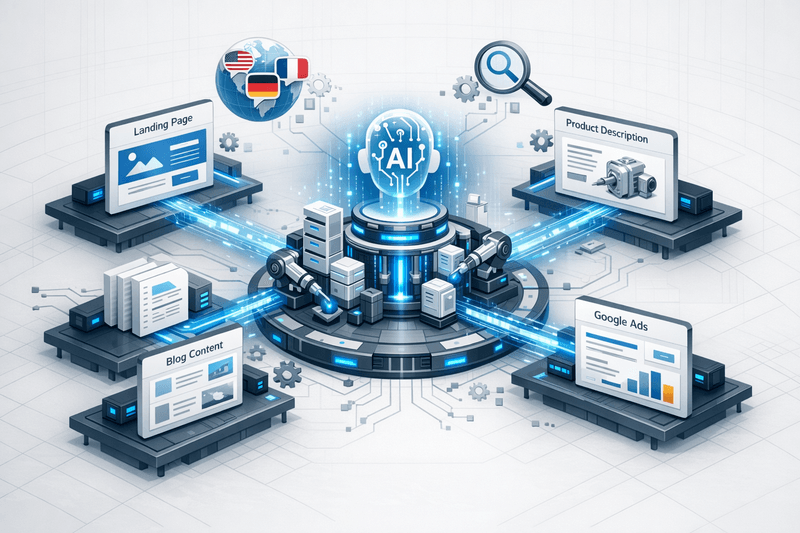
Nukipa is built exactly for this reality: As the marketing OS for SMEs, the platform automatically creates landing pages, blog posts, product descriptions, comparison pages, FAQs, and Google Ads, in multiple languages and with clear CTAs - always based on your existing expertise. You define the guardrails; Nukipa takes over content creation, planning, and publishing.
Important: All content is reviewed by your team before publishing - human-in-the-loop is part of the model, especially for safety-critical or regulated applications.
Insight 3: From datasheet to deal - how marketing automation changes lead generation in manufacturing
Build an end-to-end funnel: Visibility -> Content -> Inquiry
Hypothesis: Manufacturing SMEs that systematically turn their technical information into an automated content funnel can build a stable inbound pipeline with lean teams.
An effective funnel for manufacturing companies typically consists of these building blocks:
Landing pages for core applications
- Example: "Hygienic stainless steel pipe connections for dairies" instead of just "Products ' Pipe fittings".
- Includes: clear target application, standards, material data, temperature/pressure ranges, industry references.
Blog posts & guides that answer engineering questions
- "5 common mistakes when designing stainless steel piping in CIP systems"
- "Checklist: Which certificates do components in pharmaceutical manufacturing need?"
Comparison pages & FAQs
- "Stainless steel 1.4301 vs 1.4404 in the food industry"
- "FAQ: What are the lead times for custom-made parts?"
Google Ads & AI-search-optimized snippets
- Search terms with clear intent (e.g. "stainless steel pipe connector EHEDG certified") are linked to specific ads and landing pages.
Forms, quote shortcuts & CRM integration
- Low-friction CTAs: request samples, book a technical consultation, receive a bundle of datasheets.
Marketing automation orchestrates this funnel so that every new topic immediately results in several building blocks - and in a repeatable way.
What this looks like in practice with Nukipa
With Nukipa, manufacturing SMEs can set up such a funnel with just a few inputs:
Provide input
- Enter your website URL, upload existing catalog pages and datasheets,
- optional positioning or sales materials,
- guidelines on claims, compliance, and no-gos.
Define the campaign
- Target topic (e.g. "components for hydrogen infrastructure"),
- target markets/languages (e.g. DACH + France + UK),
- prioritized goals: more inquiries, more demo meetings, more sample orders.
Automated content creation
Nukipa generates, among other things:- thematic landing pages with clear use cases,
- blog posts and application stories,
- product and service descriptions,
- comparison pages for alternative materials or technologies,
- FAQ sections and Google Ads drafts - all optimized for classic SEO and AI search.
Review & fine-tuning by your team
- Check technical details, limits, standards,
- grant approvals by product line/region.
Publishing & continuous improvement
- Nukipa automatically publishes the content on your website or subpages,
- tracks where you appear in AI search (e.g. ChatGPT answers, AI Overviews),
- measures traffic, inquiries, and topics that actually drive leads,
- and suggests new topics and iterations based on these signals.
This creates a loop of measure -> create -> publish -> improve that generates new opportunities every week - instead of one new catalog per year.
Conclusion and next steps: How manufacturing SMEs get started with marketing automation
Marketing automation in manufacturing does not mean replacing your sales team, but supplying it with a continuous stream of better-informed, better-fit leads.
The data is clear:
- B2B and industrial buyers want to do their own research, often right up to the point of purchase. (wifitalents.com)
- Manufacturers that consistently invest in content and digital marketing see direct impact on engagement and revenue. (zipdo.co)
- AI and marketing automation are already widely used - the question is no longer "if" but "how systematically".
Concrete next steps for your company:
Audit your current website:
- For which 5-10 core applications do you already have dedicated landing pages?
- How many technical blog posts/guides have you published in the last 6 months?
Identify gaps in search & AI search:
- Which keywords and questions do your customers use? (e.g. from CRM inquiries, support tickets, field sales questions)
- Do you show up visibly for these in Google - and in AI systems?
Run a pilot campaign with marketing automation:
- Choose a clearly defined segment (e.g. a product line or industry) and use a tool like Nukipa to automatically create landing pages, blog posts, FAQs, and initial Google Ads.
- Review and refine the content internally, publish, measure inquiries.
Scale the process:
- Apply what works in the pilot to additional product lines and language markets.
- Establish a fixed weekly rhythm for review slots instead of manual copywriting.
If you want to get started without a lot of overhead, Nukipa is a particularly good fit for manufacturing SMEs: The platform acts like a marketing team in a browser tab - it plans, writes, publishes, and improves your content while your sales and engineering teams focus on customer projects.
Frequently asked questions about marketing automation in manufacturing
1. What does marketing automation actually mean for a manufacturing company?
Here, marketing automation doesn't just mean email sequences, but the end-to-end automation of your digital marketing:
- Topic discovery around applications and industries,
- creation of landing pages, blog posts, product descriptions, comparison pages, and FAQs,
- publishing and updating on your website,
- distribution via Google Ads and other channels,
- monitoring rankings, AI search visibility, and leads.
With Nukipa, most of these steps are automated based on your existing content and guidelines - you focus on approvals and fine-tuning.
2. Do I need a large marketing team to introduce marketing automation?
No. In fact, manufacturing SMEs with lean teams benefit disproportionately:
- You don't have to build a full content team or manage multiple agencies.
- A platform like Nukipa takes over recurring content creation and publishing.
- Your marketing or sales team sets topics, priorities, and no-gos and reviews the outputs.
That way, even companies with 10-200 employees can achieve a content cadence that is usually only seen in large enterprises.
3. How do I ensure that AI-generated content is technically correct?
In manufacturing, technical accuracy is non-negotiable - incorrect information about pressure, temperature, or standards can cause real damage.
That's why Nukipa follows the human-in-the-loop principle:
- The AI generates the first draft based on your datasheets, website copy, and guidelines.
- Specialist departments (product management, engineering, quality) review and adjust critical information.
- Only then is the content published.
This way you combine the speed of AI with the expertise of your teams.
4. How quickly can I expect visible results?
In our experience, SMEs that publish new content consistently see first effects within a few weeks:
- new pages are indexed,
- visibility for relevant search queries increases,
- the first additional inquiries come in.
With Nukipa, this effect is accelerated, because the platform not only creates content, but also publishes it continuously and optimizes based on traffic and AI search signals. Still important: inbound marketing is a system, not a one-off project - the full impact builds over months.
5. Can our existing agencies also work with Nukipa (white-label approach)?
Yes. Many small agencies that serve manufacturing SMEs struggle with margins and capacity in content production. With a marketing OS like Nukipa, agencies can
- automate content production for their industrial clients,
- create multilingual content without extra copywriters,
- handle reporting and campaign management,
- and use Nukipa in the background as a white-label component.
For you as a manufacturer, this means: you keep your trusted agency partner, while they can deliver significantly more output per month - at consistent quality.
Next step: If you want to test how your datasheets and specifications can be turned into AI-optimized landing pages, blog posts, and Google Ads, start with your first campaign in Nukipa and let the platform handle the rest - including publishing and ongoing optimization.