
Most B2B companies have a blog today - but hardly anyone reads it. You invest hours in a strong expert article, hit "Publish" ... and then: nothing.
It's like owning a Porsche you only drive through the car wash once a month. Impressive, but no one ever sees it on the road.
Meanwhile, your competitors are overtaking you:
- Over 80% of customers now search online for service providers
- Around 78% of all B2B purchasing decisions are influenced by digital research
- In the DACH region, 97% of B2B companies use social media, and 94.9% of them rely on LinkedIn as their most important organic channel
If your content is not showing up there - with people and in AI searches - you are invisible to many buyers.
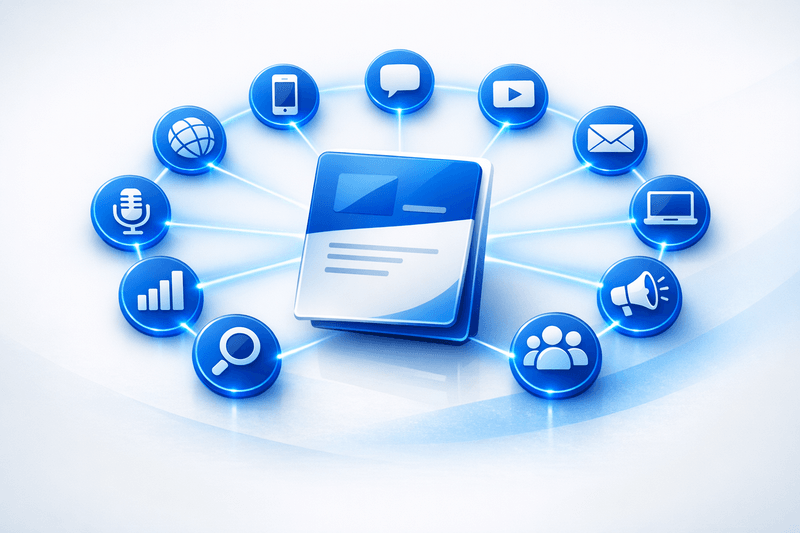
This is where owned media content distribution comes in: you build your own reach and systematically distribute every new piece of content across multiple channels. Xpert.digital puts it clearly: Owned media is becoming a survival issue in B2B marketing, because dependence on third-party platforms and their algorithms has become too great
In this guide, I will walk you through, step by step:
- how to turn a single blog post into a complete distribution package,
- which 12 channels are especially worthwhile in B2B (newsletters, LinkedIn, XING, podcasts, webinars ...),
- how to use each channel practically - without burning out your small marketing team,
- and how to put much of this on autopilot later (for example with AI-powered content marketing from Nukipa).
What you need before you start
Before you distribute content across 12 channels, make sure the basics are in place:
- Clear goal for each piece of content (e.g., demo requests, newsletter signups, webinar registrations)
- Defined target audience / ICP (e.g., heads of production in mid-sized companies with 50-500 employees)
- One "hero" content piece: e.g., white paper, report, webinar recording
- Clean destination page (landing page or blog post with a clear call to action)
- Basic tracking: web analytics, UTM parameters, campaign names
- Optional: a tool that automatically plans and publishes blog + social - for example Nukipa, which writes blog articles, optimizes SEO + GEO, and creates and schedules LinkedIn posts.
Once that's in place, we will build your distribution system.
Step 1: Clarify the role and goal of your content
Before you select channels, ask: What is this content piece for?
Ask yourself three questions:
Where in the funnel are you?
- Awareness: make the problem visible, build trust
- Consideration: compare solutions, strengthen your positioning
- Decision: remove final obstacles, reduce perceived risk
What is the one next step?
- "Download white paper"
- "Request a demo"
- "Subscribe to newsletter"
What is the core message?
- One sentence that appears in every channel - just phrased differently.
Tip: Write the core message like a Formula 1 pit board - short, clear, unmistakable. Everything you later do in newsletter, podcast, webinar & co. needs to reinforce this message.
Step 2: Turn your hero content into a distribution package
Take your hero piece (e.g., a 1,800-word blog article) and break it down into:
- 3-5 key statements/theses
- 2-3 strong graphics/slides
- 1-2 concrete examples/case stories
- 1 clear recommendation for action
From this you can create:
- teaser copy for newsletter and social
- 3-7 LinkedIn posts (carousel, text post, poll)
- an outline for a 30-45-minute webinar
- a conversation guide for a podcast episode
Mistake: Creating totally new content for every channel. Use the same content in formats that fit each channel - it saves time and boosts recognition.
Step 3: Set up minimal tracking for distribution
You do not need an enterprise setup. Lean tracking is enough:
- UTM parameters per channel (utm_source, utm_medium, utm_campaign)
- A simple campaign table (Google Sheet/Notion) with:
- publication date
- channel
- content/hook
- target URL
Ideally measure per channel:
- Newsletter: open rate, click rate, replies
- LinkedIn/XING: reach, interactions, profile visits, website clicks
- Podcast/webinar: registrations, on-demand views, downstream leads
- AI search visibility: where does your brand show up? (ChatGPT, Perplexity, Google AI Overviews etc.)
Tools like Nukipa help, because they track over 100 relevant AI search queries per week and show where your company is mentioned in AI answers - including automatic content optimization based on this data.
Step 4: 12 distribution channels for your owned media content
Now we will go through each channel - B2B-focused, DACH context, limited resources in mind:
Channel 1: Email newsletter - your most reliable owned media engine
Newsletters are your most classic and reliable channel. This is where you reach people who have already given you their attention.
How to make the most of this channel:
- One main topic per issue: Make your hero content the cover story, not a side note.
- Strong hook in the subject line (problem + benefit):
- "Why 80% of your blog posts stay invisible - and how to change it"
- Short, clear, linked: 300-500 words, 1-2 subheadings, 1 clear CTA.
- Segment where it makes sense: e.g., "existing customers" vs. "leads"
- Actively invite replies ("What is your biggest owned media challenge? Just hit reply to this email.")
Mistake: Newsletter as a "content grab bag". Better: one strong story, one clear goal.
Channel 2: LinkedIn company page - shop window for your brand
LinkedIn is the key network for B2B.
- 84% of B2B marketers say LinkedIn is their most valuable social platform
- About 25 million users in the DACH region, and 80% of all social B2B leads originate on LinkedIn
How to fully leverage your company page:
- Teaser instead of copy-paste: Summarize, take a clear stance, add a link.
- Mix formats:
- PDF carousels (charts)
- Short videos (30-90 seconds with one key insight)
- Polls on your core thesis
- Consistency over perfection: 2-3 posts per week beat one "perfect" campaign a month.
- Do not forget the comments: Your team should join the conversation.
Tip: Your blog article is the car, your LinkedIn company page is the starting grid. Without a good grid position, you will not overtake anyone.
Channel 3: Your employees' LinkedIn profiles - reach times X
Decision-makers are more likely to follow people than brands. And only 1% of LinkedIn users post regularly, yet they generate 9 billion impressions; about 80% of B2B leads come from them
How to activate colleagues as amplifiers:
- Select 3-5 key personas (CEO, sales, subject-matter experts)
- Create personalized post variants for each person (adapt tone/perspective)
- Agree on a posting rhythm (e.g., 2 posts per week)
- Build internal enablement resources (templates, hooks, visuals)
Mistake: Everyone posts the exact same text at the exact same time. Better: different angles, timings, and examples.
Tools like Nukipa can automatically create and schedule matching LinkedIn posts for every blog article.
Channel 4: XING - niche, not mass platform
XING is still alive - just in a different way.
- Only 10-27% of B2B companies still use XING actively, while LinkedIn dominates
It can still be worthwhile in DACH for:
- Recruiting and employer branding: showcase your culture and projects
- Industry/regional groups: share expert articles and webinar invitations
- Events: use XING events for webinars
Use XING selectively, but invest primarily in LinkedIn and your own channels.
Channel 5: Guest articles in trade media - borrowed authority
Guest contributions give you:
- Targeted audience reach
- Authority via context
- Backlinks for SEO/GEO
Here is how to approach it:
- Rework your hero content into an independent expert article (no product pitch)
- Research 5-10 industry publications
- Send pitches with 3-4 bullet points explaining why the topic fits
- Add an author bio with a link to your own resource page
Over time, recurring columns and series can turn you into a recognized voice in your industry.
Channel 6: Association and partner newsletters - borrow reach, keep the leads
Many associations and tech partners run their own newsletters for your niche.
How to use them:
- Short, neutral teaser (2-3 sentences + graphic)
- Co-branded content (for example, a guide produced together with [Association XY])
- Always link to your own landing page (you keep the lead)
Never leave content only on the partner's side - always point back to your own channels.
Channel 7: Your own expert podcast - depth over breadth
Podcasts are ideal for complex B2B topics. Listeners actively choose audio:
50.1% of B2B podcast listeners use Spotify, 28.6% YouTube, 12.5% Apple Podcasts; the 30-49 age group is the most important B2B target audience
Use podcast and content together like this:
- Turn every major article into a podcast episode (solo or interview)
- Use show notes with links to guides, checklists, and webinars
- Cut short clips (30-60 seconds) for LinkedIn and YouTube Shorts
- Always include a call to action ("Download the checklist in the guide")
Audio builds deep trust - 30 minutes in someone's ears beats any banner ad.
Channel 8: Guest appearances on podcasts - tap into existing audiences
Running your own podcast takes time. Faster path: guest spots on established B2B podcasts.
How to do it:
- Research (niche) podcasts, listen to 1-2 episodes
- Send specific topic suggestions based on your hero content
- Actively promote the episode in your own network
Reuse every recording twice - as a blog post, social snippets, and newsletter asset.
Channel 9: Your own webinars - live interaction with intent
Webinars remain powerful lead engines in B2B. Here is how to make them work:
- Use the blog structure as your webinar agenda (3-5 sections)
- Add live elements: polls, Q&A, demos
- Host the recording on an on-demand landing page
- Link to this page everywhere (blog, newsletter, LinkedIn)
Webinars are content hubs, not one-off events: keep reusing the recordings.
Channel 10: Partner webinars and virtual events - shared reach
Partner webinars are like a temporary Formula 1 alliance: two teams, one joint strategy.
How to set them up:
- Look for complementary partners (same audience, different offer)
- Develop a joint (neutral) topic
- Clarify in advance:
- Who invites whom?
- How are leads shared?
- Who handles moderation/follow-up?
- Use both of your owned media stacks for promotion
After the webinar, continue to develop the contacts via your own channels.
Channel 11: Video and YouTube - visibility for people who do not like reading
Not everyone wants to read - video helps. YouTube matters in B2B:
55.8% of B2B companies use YouTube actively - after LinkedIn, Instagram, and Facebook
How to use video:
- Turn the blog article into a 5-10-minute explainer video (a screencast plus voiceover is enough)
- Upload, then optimize title/description for your keywords
- Embed the video in the blog post
- Turn short clips (30-60 seconds) into LinkedIn posts
Do not wait for a studio. B2B buyers want clarity, not cinema-quality production.
Channel 12: Sales and customer success - bring content straight into buying journeys
The most underrated channel: your sales and customer success teams.
How to integrate content:
- Email templates for sales (guides/webinars as links addressing typical objections)
- Use onboarding sequences (how-to videos, best-practice guides)
- Include content in QBRs (quarterly business reviews) to uncover upsell potential
Think of content as a digital sales kit that works for you 24/7.
Step 5: Build a repeatable distribution workflow
Twelve channels? You do not have to use all of them all the time. Develop a standard workflow:
- Day 0 - publication:
- Blog/landing page goes live
- First LinkedIn posts (company page + 1-2 personal profiles)
- Day 1-3 - newsletter and groups:
- Send newsletter with the main story
- Share in 1-2 LinkedIn/XING groups (no spam)
- Day 4-10 - deep dive and partners:
- Announce webinar or live session
- Pitch guest article/podcast appearances
- Day 10+ - evergreen:
- Use the content as evergreen in nurture flows, sales, and onboarding
- After 3-6 months, recycle it with a fresh hook
Better to work consistently with 5-6 channels than to touch all 12 once. Start with newsletter, LinkedIn (page + profiles), webinars, and one partner channel; then scale up.
With tools like Nukipa, you automate content, posts, planning, and publishing - including SEO + GEO optimization directly on your domain.
Step 6: Measure, learn, automate
Focus on a few KPIs per channel:
- Newsletter: click rate on hero content, replies
- LinkedIn/XING: profile visits, website clicks, direct leads
- Podcast/webinar/video: registrations, watch time, leads
- Customer success: shorter sales cycles, win rate, upsell
- AI visibility: presence in ChatGPT/Perplexity answers for "best solution for [your industry]"
Eli Schwartz emphasizes: those who deliver real value and optimize for user intent win in both AI and classic search results. To do that, you need consistent owned media structures and content that delivers the same promise across every channel.
Tools like Nukipa make this easier:
- Up to 50 blog articles, 60 social posts, 8 languages - all automatically (from €490/month), SEO + GEO optimized, on your own domain
- Autopilot content plan (coordinating blog and social)
- AI prompt tracking: monitor how you appear in AI searches
You will find more details here: Nukipa pricing and plans.
Next steps: Your 7-day mini action plan
To make this tangible, here is your roadmap:
- Day 1:
- Choose one hero content piece
- Define goal, core message, next step
- Day 2-3:
- Create: 1 newsletter, 3 LinkedIn posts, 1 webinar outline
- Day 4-5:
- Identify 3 trade media outlets, 3 podcasts
- Write short pitches
- Day 6-7:
- Plan webinar/live session
- Set up simple tracking (spreadsheet)
Does this small round already push you to your limits? That is normal in mid-sized B2B companies. That is why solutions like Nukipa exist - your marketing "on autopilot".
FAQ: Common questions about owned media distribution
How many channels do I really need to use?
Start with 3-5 core channels:
- Newsletter
- LinkedIn (company page + 1-2 personal profiles)
- Webinars or podcast appearances
- One partner channel (trade publication or association newsletter)
Only add more channels once these are running smoothly.
Is it not too much to push the same content everywhere?
No - as long as you adapt form and focus to each channel:
- Blog: in-depth
- Newsletter: story + context
- LinkedIn: thesis + discussion
- Podcast: deep dive
- Webinar: interactive
Most people will only see 1-2 formats. Repetition actually boosts your expert status.
How do I avoid pure self-promotion?
Rule of thumb: 80% value, 20% promotion.
- Share tips, checklists, common mistakes
- Show real examples from projects (without sharing client details)
- Only bring in your product where it is clearly part of the solution
Owned media only works on the basis of trust. Promotion is the side effect.
Do I still need paid media then?
Paid media remains a traffic accelerator:
- To promote your most important owned assets (reports, webinars, guides)
- For retargeting via website and webinar visitors
Your goal: more and more interaction via your own channels. Paid helps to kickstart that.
How am I supposed to do all this as a solo marketer?
You cannot fully cover everything manually - and that is perfectly normal.
Here is what you can do:
- Focus on 3-5 channels
- Keep processes lean (reuse instead of recreating content)
- Automate wherever possible:
- Planning
- Social snippets
- Publishing and reporting
Tools like Nukipa take care of research, content creation, social, and publishing. That leaves you free to stay strategic, choose topics, and manage quality - the essential parts of good B2B marketing work.