

Most industrial companies in the DACH region are world-class technically - but almost invisible online. Your machines, systems, or services are best-in-class, but when someone asks ChatGPT, Google, or Perplexity for potential suppliers, you simply don't show up.
Current analyses show: brands that are cited in AI overviews increase their organic click-through rate by an average of 35%. Companies without strong owned content remain invisible in an AI-driven world.
At the same time, demand is shifting online:
In the skilled trades, over 80% of customer inquiries now start digitally - for example via search engines or review platforms. This pattern has long applied to many B2B industries as well.
Decision-makers expect substance:
99% of B2B decision-makers consider thought leadership content important in the buying process; 66% consistently avoid vendors with weak thought leadership.
In this guide you'll learn, step by step:
- which 15 owned media formats are especially valuable for B2B industrial companies
- which target groups and funnel stages they address
- how to produce them pragmatically with limited marketing resources
- how to set up a simple content calendar and workflow
- how to put everything on autopilot for SEO and GEO (AI search) - for example with an AI-powered platform like Nukipa
Prerequisites: What you should clarify before you start
Before you dive in, you need a minimum foundation. You don't need a 10-person marketing team, but these basics should be in place:
- Target customers & stakeholders
- 2-3 core roles: e.g., Head of Maintenance, Plant Manager, Head of Procurement, CTO
- Typical questions per role along the customer journey (Research -> Shortlist -> Business Case -> Roll-out)
- Clear positioning framework
- 2-3 topic areas for which you want to be known as an "industry voice" (e.g., predictive maintenance, energy efficiency, occupational safety)
- Owned media foundation
- Website with blog/news section or knowledge hub
- LinkedIn company page + 1-3 active personal brands (CEO, Sales, Engineering)
- Optional: YouTube channel or video section on the website
- Measurement setup (light)
- Web analytics (e.g., Matomo, GA4)
- Basic lead tracking (CRM or a structured Excel/Notion list)
- Medium term: AI search monitoring (e.g., GEO and prompt tracking like with Nukipa, monitoring 100+ prompts per week)
- Resource check
- 0.5-1 day per week for marketing (can also be management plus assistant)
- 1-2 subject-matter experts who can schedule 15 minutes per week for interviews
- Budget for minimal video/audio production or external support
If this roughly fits, you can get started.
Step 1: Why owned media & thought leadership are critical for survival in B2B
Many industrial companies still rely on "trade shows, brochures, press releases." But visibility works very differently today:
- AI answers (Google AI Overviews, ChatGPT, Perplexity) are handling more and more search queries directly.
- Organic clicks from classic SERPs are dropping not because "SEO is dead," but because many questions are answered on the spot.
- Visibility is shifting: who is cited as a trusted source by AI systems?
Xpert.Digital puts it clearly: owned media - your own channels with genuine industry expertise - are the answer. If you rely only on third-party platforms and paid traffic, you lose reach the moment algorithms or ad prices change.
Think of it like motorsport:
- Paid media is a guest drive on someone else's track - expensive, time-limited, and the rules are set by others.
- Owned media is your own test track. You control the layout, pace, data, and timing.
Your goal: build an impact engine that turns expertise into content, makes it visible, and converts trust into leads - instead of waiting every year for the next trade show to save the pipeline.
Step 2: Define target audiences & topic clusters
Before you define formats, clarify who you're talking to and what you want to be known for.
2.1 Typical stakeholders in B2B industrial sales
- Technical decision-makers (engineers, maintenance, production managers) - look for technical depth, specifications, integration effort
- Economic decision-makers (CFO, plant management, executive management) - look for business case, risk, payback, references
- Purchasing & procurement - look for comparability, TCO, delivery capability, compliance
- Users & operators - look for usability, training, real-world examples
2.2 Topic clusters instead of one-off articles
Define 3-5 topic clusters. For example:
- Use cases & applications (real-world stories, case examples)
- Technology & engineering (deep dives, architecture, standards)
- Market & regulation (standards, ESG, energy costs, supply chains)
- Productivity & ROI (business cases, TCO, benchmarks)
- People & competence (employee stories, training, employer branding)
These clusters are your "roadbook." The 15 formats you're about to see are the different race cars you'll deploy on those routes.
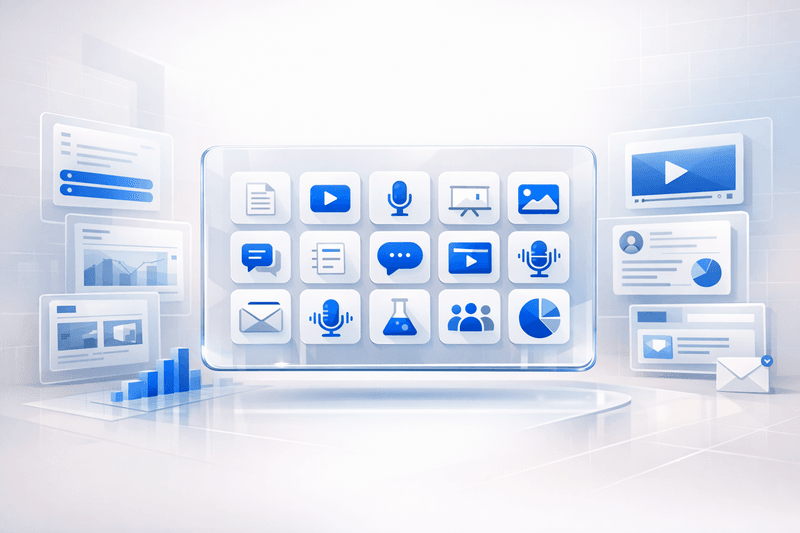
Step 3: The right content formats - 15 owned media ideas from the field
You don't have to cover all 15 formats right away. The goal is a format mix that fits your target customers, resources, and channels.
Companies that use at least four different content formats in a coordinated way achieve, on average, around 41% higher conversion rates than mono-format strategies.
3.1 Expert articles & technical blog posts
For whom?
- Engineers, maintenance teams, technically minded decision-makers
Objectives:
- SEO + GEO visibility for problem-driven searches
- E-E-A-T signal: "We are the experts, not just the marketing department"
How to do it:
- Start with customer questions from service and sales.
- Run a 15-minute interview with a subject-matter expert.
- Turn it into a structured article (in-house or AI-assisted, e.g., with Nukipa).
- Add diagrams, photos, sketches.
Mistake: Writing too abstractly ("We are your partner for Industry 4.0"). Be specific: "How to reduce lubricant consumption by 20%."
3.2 Use cases & case studies (customer success stories)
For whom?
- Management, procurement, technical decision-makers, shortlist stage
Case studies combine storytelling with numbers and are the top B2B format for building trust and proving competence.
Blueprint:
- Starting point (industry, size, challenge)
- Main challenge (e.g., regulations, legacy systems)
- Solution (your approach, technology, implementation)
- Results (KPIs, quotes, before/after photos)
Practical example:
- A logistics provider installs an automated shuttle system.
- Documented: 25% space gain, 18% fewer errors, ROI in 2.5 years.
- From that: 1 case study, 2 blog posts, 3 LinkedIn posts, 1 sales one-pager.
Tip: Let the customer speak. "We were able to eliminate the night shift ..." hits harder than product copy.
3.3 White papers & e-books
For whom?
- Early to mid-stage decision-makers
White papers and e-books are the B2B classics for lead generation and thought leadership.
Topics:
- "Guide to predictive maintenance in mechanical engineering"
- "Energy efficiency in paint shops: 7 levers with business case examples"
- "Standards & safety in XYZ applications 2026"
Implementation:
- Consolidate existing material (presentations, memos, talks).
- Structure it as Problem -> Options -> Approach -> Checklists.
- Offer the white paper as a lean download.
- Repurpose the content (blog, newsletter, social).
Mistake: Asking for too much data in the form. Keep it short: name, company, email is enough.
3.4 Market & trend analyses ("industry outlook")
For whom?
- C-level, business development, strategy
Decision-makers want orientation on energy prices, supply chains, regulations.
Formats:
- Annual industry report (PDF plus microsite)
- Quarterly update as a blog article
- Charts (capacity utilization, energy consumption)
Best practice:
- Xpert.Digital uses data-driven analyses to position itself as an "industry hub" for smart factory - with content series instead of one-off campaigns.
3.5 CEO/CTO columns ("market reflections")
For whom?
- Decision-makers, press, opinion leaders
This is not about features but perspective: where is the market heading? Which myths are wrong? Where is courage needed?
Studies show: strong thought leadership content increases trust and willingness to pay. Companies with consistent thought leadership see higher repeat purchase rates and command prices up to 14% higher.
Formats:
- Monthly LinkedIn articles from the CEO
- "Letter from the CTO" quarterly as blog + newsletter
- Short video statements (3-5 minutes) on industry news
Tip: The CEO's voice doesn't replace the expert level; it sets guardrails and vision.
3.6 Behind-the-scenes factory videos
For whom?
- Technical decision-makers, young talent, press
Show what makes you different: QA, test rigs, assembly. Authentic insights are more convincing than polished image films.
How to do it:
- Choose 3-5 key stages in your value chain.
- Shoot short clips (vertical for social, horizontal for YouTube).
- Add overlays: "Why we inspect twice," "How we detect faults early."
Live and video formats generate around 35% more engagement in B2B and are watched about 15 minutes longer than standard videos.
Mistake: Overproducing. A workbench with oil stains is often more credible than a sterile studio.
3.7 Live demos & Q&A sessions (webinars, livestreams)
For whom?
- Prospects in active evaluation, existing customers
Live formats are your digital trade show booth - but scalable.
Use cases:
- Live commissioning
- Q&A with design engineers
- Troubleshooting office hours for customers
Pro tip:
- Record every session, cut it into clips, and reuse as FAQ content.
Mistake: Pure product demos without interaction - plan for polls, chat feedback, and live questions!
3.8 Video podcast with industry experts
For whom?
- Decision-makers who consume content on the go (car, train, hotel)
"The Infinite Dial 2025": Around 45% of B2B decision-makers regularly listen to industry-specific podcasts, averaging 39 minutes per episode.
Ideas:
- "Inside Intralogistics" - conversations with logistics heads
- "Future of Manufacturing" - CTOs on AI and automation
Content leverage:
- Audio -> podcast platforms
- Video -> YouTube & website
- Transcript -> blog, LinkedIn, newsletter
Tip: A clear segment structure reduces prep time and strengthens recognition.
3.9 How-to guides & checklists
For whom?
- Engineers, maintenance teams, project managers
How-to guides are your bread-and-butter format: concrete instructions like "How to plan a retrofit in 6 steps" or "Checklist: selecting an AMR system."
These are ideal for SEO & GEO: problem-oriented and expert-driven.
Mistake: How-tos that are too generic. Be specific and tailored to your industry.
3.10 Knowledge base / FAQ hub & glossary
For whom?
- All stakeholders - especially in the research phase
A well-structured knowledge base is owned media gold:
- FAQ articles
- Glossary of technical terms and standards
- Short explainer videos
Search engines and AI systems prefer structured knowledge sources - this is where you build topical authority that directly strengthens GEO.
3.11 Interactive tools & calculators
For whom?
- Economic decision-makers, engineering, partners
Examples:
- ROI calculator for energy efficiency
- TCO comparison, old vs. new
- Configurator (e.g., payload for a crane or lifting system)
These tools take more effort to build but generate high-quality leads and are frequently cited.
Tip: Start small (Excel download), then evolve into a web-based version.
3.12 Project diaries ("from idea to commissioning")
For whom?
- Prospects, customers, young talent
Follow a reference project over time:
- Kick-off, concept, implementation, go-live, lessons learned
Perfect for social snippets and a transparent look at how you work.
3.13 Training & onboarding content (public)
For whom?
- Customers, prospects, partners
Share anonymized excerpts from e-learning modules or manuals publicly:
- "Operator quick guides" as blog posts
- Video clips from training sessions
- Micro-trainings ("5 mistakes to avoid when maintaining XYZ")
This builds trust and reduces support effort.
3.14 Employee stories & expert profiles
For whom?
- Customers, applicants, media
Especially in mid-sized businesses, people matter. Show your "drivers":
- Profiles with photo & favorite project
- Expert interviews
- Trainee diaries
These formats strengthen trust and employer branding.
3.15 Newsletter as the "glue" for your owned media
For whom?
- Everyone you want to reach independently of social platforms
Your newsletter ties everything together:
- Overview of new articles, videos, and reports
- "From the field" section
- Clear CTA (e.g., webinar, consultation)
Mistake: Turning it into pure promo spam instead of acting as the curator of your best content.
Step 4: Set up a lean content calendar (incl. template)
Less is more: aim for a realistic rhythm - avoid idea overload.
4.1 Minimal setup for industrial SMEs (10-200 employees)
Per month:
- 2 expert articles / how-tos
- 1 use case or project story
- 1 CEO/CTO statement
- 1 video or live format
- 1 newsletter
With AI automation like Nukipa, you can automatically generate LinkedIn posts, snippets, and language versions from a single core article - and publish them directly.
4.2 Calendar template (90 days)
Use a structure like this (Excel, Notion, or your tool of choice):
| Week | Cluster | Format | Title | Target role | Funnel | Channel(s) | Owner | Status |
|---|---|---|---|---|---|---|---|---|
| Week 14 | Use Cases | Case study | Retrofit line 3 at OEM X | Plant manager | Consideration | Blog, LinkedIn, newsletter | Marketing, Sales | Idea |
| Week 15 | Tech | Expert article | Early detection of bearing damage | Maintenance | Awareness | Blog, SEO, GEO | Engineering, Marketing | In progress |
| Week 15 | People | Factory video | End-of-line testing explained | Customers, applicants | Awareness | YouTube, Blog, LinkedIn | Marketing | Planned |
Key points:
- Every piece of content has a target role and funnel stage.
- Plan repurposing from the start (Blog -> Social -> Newsletter -> Sales collateral).
Tip: Plan conservatively and overdeliver. With Nukipa you can easily scale output and languages later.
Step 5: A production workflow that fits industrial reality
The biggest hurdle is rarely "lack of ideas," but time and structure. Here's how a workflow can look:
- Collect input (ongoing): Sales and service submit questions and stories weekly - via a form or Teams channel.
- Prioritize (30 minutes every 2 weeks): Marketing and experts pick 3-4 topics.
- Expert interviews (2 × 15 minutes/week): Record short interviews. Ask questions like: "What is the most common root cause of ...?"
- Content creation (AI-assisted): Raw transcript -> article/checklist/case study, e.g., with Nukipa.
- Review & approval (max. 30 minutes): Expert checks content; marketing checks structure & CTAs.
- Publication & distribution (on autopilot): Publish on the blog and schedule social teasers automatically.
- Analysis & GEO feedback: Monthly mini-report plus AI search tracking - where are you already showing up?
Mistake: Marketing working alone = bottleneck. Flip it: experts talk, AI and marketing do the writing.
Step 6: Measuring success - for humans and AI search
Old KPI logic ("more traffic") is not enough: what matters is where you're visible - and whether real conversations follow.
6.1 Core KPIs for owned media
- Page views
- Time on page / scroll depth
- Downloads, leads, demo requests
- Replies to newsletters
- Pipeline volume & sales impact
Companies with strong thought leadership shorten their sales cycles by weeks and achieve around 14% higher margins.
6.2 Measuring GEO & AI search
This is the new playing field:
- For which ChatGPT/Google prompts are you mentioned?
- Which pages are directly linked or cited by AI?
Currently, 55.5% of marketers are seeing rising clicks despite AI overviews - especially when their brand appears as a cited source in AI answers.
Tools like Nukipa track over 100 relevant prompts per week and show you where you already appear as a source - and where you can still build topical authority with targeted content.
Tip: Connect GEO data with sales: which prompts correlate with better close rates? Invest deliberately in those topic clusters.
Step 7: Get momentum within 4-8 weeks
You don't need to build a media company. The goal is to realistically shift your marketing towards owned media and thought leadership.
Concrete 30-day plan:
- Week 1: Define goals, topic clusters, stakeholders, and a 90-day calendar
- Week 2: Record 2 expert interviews, produce 1 expert article and 1 how-to
- Week 3: Document 1 use case and shoot 1 behind-the-scenes video
- Week 4: Set up your newsletter, optimize first pieces for GEO/SEO, and start a mini-reporting routine
With an AI-powered platform like Nukipa, you can put most of this process on autopilot: topic discovery, article creation, LinkedIn posts, scheduling, and AI search tracking in a single tool - "a marketing team in one tab." Pricing & details: Nukipa pricing from €490/month.
FAQ
1. One marketing person - how many formats are realistic?
Start with 4 core formats:
- Expert articles / how-tos
- Case studies
- CEO/CTO posts
- Newsletter
You can add video, podcast, and live formats once your basic rhythm is in place or you've automated more of the work. Quality and consistency beat sheer volume.
2. How long does it take for owned media to show results?
In B2B, thought leadership usually takes 12-24 months to fully impact brand, margin, and deal velocity.
You'll often see early signals (more inquiries, more focused conversations, media outreach) within a few months - especially when sales and marketing are closely aligned.
3. Is a CEO personal brand mandatory?
Helpful, but not mandatory. The main thing is: 2-3 visible voices
- CEO (vision & market), CTO (technology & roadmap), Head of Service (real-world practice)
Better a monthly CTO column than three hyped CEO posts followed by months of silence.
4. SEO vs. GEO - the simple difference
- SEO = visibility in search result lists (Google, Bing)
- GEO (Generative Engine Optimization) = visibility as a cited source in AI answers (ChatGPT/Perplexity/Google)
What matters:
- More focus on expertise, authority, trust (E-E-A-T) instead of just keyword density
- Clear authors, verifiable data, solid analysis
- Structured FAQs, how-tos, white papers, strong case studies as ideal "training material" for AI
Owned media is the foundation for both - without strong owned content, there is no visibility. Period.
5. Is a corporate blog worth it if most leads come from trade shows?
Absolutely - especially then.
Trade shows are point-in-time events. Today, customers research for months before and after. Without a blog/owned media, this happens:
- You have a great conversation at the show.
- The decision-maker later googles or asks ChatGPT.
- They find: nothing or very little - and remember the competitor who consistently showcases their expertise.
Your blog is not an "online diary" but the central expert hub: it's where you anchor all formats - discoverable for both humans and AI.
If you like, the next step can be a concrete 90-day owned media plan built from your existing presentations and project stories - including recommendations on what you can already put on autopilot with AI.