
AI in marketing has long since become more than a smart copywriter: over the next 2-3 years, agents, skill stacks built around Claude, and specialized platforms like Nukipa will automatically manage entire campaign chains. This article shows where AI marketing automation is heading, what role Claude Marketing Skills play in it - and how SMBs and SaaS teams should prepare today.
Key Takeaways at a Glance
- Marketing automation is already mainstream: Around 71% of companies are already using marketing automation or are in the process of introducing it; automated workflows save on average more than six hours of routine work per week. (primal.com.my)
- GenAI is transforming the role of marketing: Studies show that generative AI can increase productivity in marketing by around 9% of total marketing spend - with the potential for 20-40% higher conversion rates and up to 30% more marketing ROI. (mckinsey.de)
- AI in marketing will be ubiquitous in just a few years: In current surveys, more than 60% of teams already use AI actively; other analyses expect that by 2027 around 95% of all marketing teams will use AI tools and that by 2030 up to 75% of marketing execution will be automated. (fratzkemedia.com)
- Claude Marketing Skills & agent stacks professionalize the DIY approach: Open-source skill collections like "Marketing Skills for Claude Code" bundle over 20 specialized skills for SEO, CRO, content, email, and analytics and turn Claude into an orchestratable campaign agent. (marketing-skills.com)
- AI-first platforms remove complexity for non-experts: Solutions like Nukipa act as an "AI Marketing Desk": they plan, write, publish, and optimize landing pages, blog posts, and Google Ads automatically - including tracking where a company appears in Google, ChatGPT, and AI search systems.
- Governance, not technology, becomes the bottleneck: The biggest hurdles for AI in marketing are already skill gaps, security, and integration - not missing models. Without clean processes, data quality, and human-in-the-loop review, silos, inconsistency, and reputational risks loom. (gartner.com)
1. From Text Generator to Campaign Agent: How Claude Marketing Skills Are Changing the Stack
Using Claude Marketing Skills specifically for campaigns
Claude is no longer just a chatbot that suggests a few headlines. Entire skill ecosystems are emerging around Claude that map out marketing workflows.
One example is "Marketing Skills for Claude Code": an open-source package that installs more than 20 specialized skills into a Claude environment with a single command - structured into modules for core functions, SEO, conversion optimization (CRO), content, email, analytics, and training. (marketing-skills.com) With this, Claude can, among other things:
- prepare keyword research, competitive analysis, and programmatic SEO,
- write blog posts, landing pages, ad copy, and email sequences along a defined funnel,
- run campaign reports, funnel analyses, and ROI evaluations.
Additional toolkits like AgentKits Marketing or ClaudeKit Marketing go even further and bundle dozens of specialized AI agents (for example for lead generation, programmatic SEO, Google Ads optimization, or community management) including commands and integrations. (agentkits.net) At the same time, Anthropic itself demonstrates how Claude is used in practice: an internal setup automatically generates ad creative variations in Figma and Google Ads copy - cutting creation time per ad from 30 minutes to about 30 seconds. (claude.com)
In parallel, Claude is evolving toward a RPA replacement with "Computer Use": the model can read interfaces, control mouse and keyboard, and operate tools that previously had to be painfully integrated via API or classic RPA. (stefangolling.de) For marketing, this means: AI agents will in future not only generate content, but also navigate analytics dashboards, duplicate campaigns, or trigger A/B tests.
Hypothesis for the next 2-3 years: Claude-based marketing skills will become a standard building block in technical teams. Marketing-ops roles will build internal "AI playbooks" from them that allow campaigns to run semi- or fully automatically from ideation to reporting.
What this means for marketing teams
The consequence: anyone using Claude & co. only as a better copywriter is leaving a lot of potential untapped.
- Roles are shifting: Away from "I write posts" toward "I design workflows." Marketing teams document brand voice, messaging, approval processes and build AI workflows on top of them - Claude becomes the execution engine.
- Tech know-how is moving into marketing: Skill stacks like "Marketing Skills for Claude Code" clearly target technically savvy marketers or growth teams. Without a basic understanding of repos, projects, and automation tools, much of the potential remains unused.
- SMBs fall behind if they try to solve everything DIY: For smaller teams without marketing and dev resources, this DIY approach is often too complex. This is exactly where AI-first platforms come into play, packaging the same intelligence into a fully orchestrated product.
Nukipa is one such example: instead of teams cobbling together their own Claude skills, they get an AI marketing platform that automatically creates, publishes, and iteratively improves landing pages, blog posts, Google Ads, product/service descriptions, FAQs, and comparison pages - including tracking of visibility in AI search engines.
2. From Efficiency to Growth: AI Marketing Automation Delivers Measurable ROI
AI boosts productivity & performance - far beyond pure copy
The first wave of AI in marketing focused heavily on "writing faster." The data now shows: the lever is significantly bigger.
Analyses from various studies put the productivity gain in marketing from generative AI at over 50% on average - many teams save 40-60 hours of marketing work per month when they automate content creation, research, and reporting. (hashmeta.ai) In a detailed analysis, McKinsey concludes that generative AI can increase productivity in marketing by around 9% of the total marketing budget. (mckinsey.de)
At the same time, an industry analysis shows that AI-powered campaigns achieve 35-50% better performance metrics, reduce customer acquisition cost by around 30%, and increase marketing-driven revenue in the first year of AI use by roughly 45% on average. (hashmeta.ai) McKinsey further estimates that AI-generated content can reduce advertising costs by around 40% without lowering ad pressure, and that conversion rates can increase by 20-40% - with potentially up to 30% higher marketing ROI. (mckinsey.de)
The adoption is there as well: in recent surveys, more than 80% of marketers state that they actively use generative AI; over 90% of CMOs report clear or very clear ROI. (techradar.com)
Interpretation: Move away from "more content" toward measurement & closed feedback loops
The numbers send a clear message: AI is not just an efficiency toy; it's a growth driver. To unlock that, marketing teams need to do three things:
Prioritize use cases that are directly tied to revenue
Instead of "AI for everything," it's worth focusing on a few, highly impactful areas:- always-on landing pages for core offerings,
- pillar blog content for search and AI visibility,
- performance-critical Google Ads campaigns,
- email flows for lead nurturing.
Establish measurable feedback loops
Top performers tightly couple AI content with analytics: which pages actually generate leads? Which keywords bring not just traffic, but qualified opportunities? Which AI answers in chatbots or AI search systems already point to the company's brand - and where are fitting landing pages still missing?Platforms like Nukipa integrate these loops directly: prompt tracking shows for which queries a company already appears in ChatGPT & co.; performance signals from website traffic, ads, and real inquiries feed back into content planning.
Institutionalize iterative work
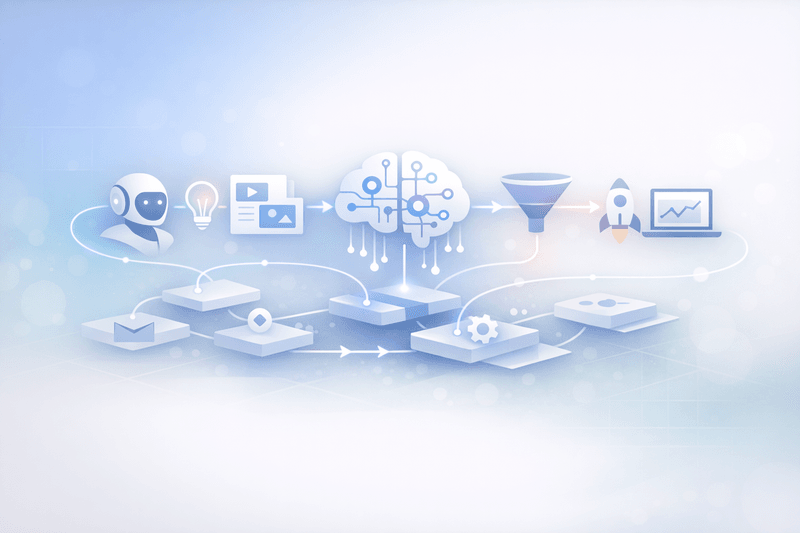
Instead of running one-off campaigns, AI-first teams rely on weekly iteration: content is regenerated, tested, improved - a cycle of "Measure -> Create -> Publish -> Improve," as Nukipa describes the core principle of its platform.
In short: Anyone using AI marketing automation merely to churn out more content faster is wasting ROI. What really matters is the closed loop between data, AI creation, and continuous optimization.
3. AI Search, AI Content & Always-on Inbound: How Lead Generation Is Changing
Aligning marketing with AI search and new touchpoints
The major search and recommendation spaces are changing rapidly: alongside classic Google search, there are AI overviews, ChatGPT answers, AI-powered product recommendations, and industry-specific chatbots. For SMBs, this means: visibility no longer comes from SEO rankings alone, but from whether AI systems recognize and recommend a company as a relevant answer.
AI marketing platforms like Nukipa are designed exactly for this point. They
- automatically turn company expertise into search-optimized landing pages, blog posts, FAQs, comparison pages, and Google Ads,
- localize content for relevant markets (e.g. DACH, France, UK),
- continuously publish and update this content so that companies remain visible in Google, ChatGPT, and other AI search engines and appear as "local experts."
As a result, inbound marketing is shifting:
- Instead of isolated blog posts, content clusters emerge that cover a topic comprehensively from an AI's perspective.
- Landing pages are optimized not only for keywords but for specific questions and use cases ("Which SaaS is best for...?" instead of just "[category] software").
- Multilingual content becomes the norm because AI search systems serve users in their respective language.
Implications for SMBs & SaaS teams
For B2B software companies and service providers with limited marketing resources, this has two major implications:
"Set and forget" no longer works
Anyone who updates their website once a quarter will lose out to competitors who, with AI-powered content automation, publish new, relevant landing pages, comparison pages, and product descriptions on a weekly basis. Nukipa addresses exactly this gap by having AI agents keep websites continuously up to date and thus ensure an always-on presence in search and AI systems.Lead generation is shifting toward "AI-ready content"
What matters is no longer just whether humans understand a page, but whether models understand it: clear structure, well-structured FAQs, comparison tables, concise value propositions. AI marketing automation helps deliver this kind of content consistently - and roll it out in parallel as blog posts, landing pages, Google Ads, and even snippets for chatbots or AI assistants.
For teams currently sitting on a content backlog, this is an opportunity: AI tools like Claude (with marketing skills) and platforms like Nukipa can turn existing documentation, release notes, and sales materials into a scalable inbound engine in a short amount of time. (claudeformarketing.com)
4. Limits, Risks & Governance: Why Humans Need to Stay in the Loop
Common pitfalls when scaling AI marketing
Impressive as the numbers are, rolling out AI-powered marketing automation is not automatic success.
- Skill gaps & integration: In surveys, marketing leaders name missing skills, security concerns, and integration issues as the main barriers to GenAI adoption. (gartner.com) The technology is there, but orchestrated use is often lacking.
- Data quality & fairness: McKinsey points out that publicly trained models come with copyright and bias risks; without governance, flawed or discriminatory recommendations may result. (mckinsey.de)
- Agent silos instead of end-to-end automation: Studies on AI agents show that companies risk creating new silos - separate agents for reporting, content, ads that don't play nicely together. Gartner expects that by 2028 a significant share of day-to-day business decisions will be automated and that a third of GenAI interactions will involve autonomous agents, but warns of insufficient orchestration. (techradar.com)
New platform risks are also emerging: white-label AI marketing solutions allow agencies to sell their own AI ad platforms under their own brand - including landing page builders, creative AI studios, and cross-channel ads. (plai.io) This is powerful, but also increases the risk of opacity for end customers when it's unclear how decisions are made.
Practical guidelines for the next 24-36 months
To benefit from Claude Marketing Skills, AI agents, and platforms like Nukipa without losing control, the following principles have proven effective:
Clear scope per tool
Define what you use Claude-based skills for (e.g. ideation, exploration, first drafts, technical QA) and what an AI marketing platform is responsible for (e.g. structured landing pages, blog automation, ad setups, monitoring).Make human-in-the-loop mandatory
Nukipa explicitly requires that all AI outputs be reviewed by qualified humans before publication - an approach every company should adopt: clear review thresholds, checklists for facts, branding, and compliance.Document brand voice & guardrails
Claude is particularly strong at applying a defined brand voice consistently - provided it is well documented (tone, do's & don'ts, examples). Skill stacks like "Marketing Skills for Claude Code" or Claude workflows in projects only unfold their full value under these conditions. (claudeformarketing.com)Clarify feedback loops & ownership
Who is responsible when an AI agent makes false statements, processes sensitive data, or makes inappropriate claims? Marketing automation needs clear accountability - and logs that make it possible to trace how a piece of AI content was created.Scale gradually instead of a big bang
Teams that are successful today start with a few core processes (e.g. blog automation and landing pages for one core product), achieve stability and transparency there - and then expand step by step to ads, email flows, additional languages, or white-label services.
Conclusion: How to Lay the Groundwork for AI-Powered Marketing Automation Today
The next 2-3 years will fundamentally change marketing automation:
- Claude Marketing Skills and agent stacks are taking DIY automation to a new level - especially for technically strong teams.
- AI-first platforms like Nukipa make always-on inbound realistic even without an in-house marketing team by automating and continuously improving content creation, SEO-like AI search optimization, landing pages, blog posts, and Google Ads.
- Anyone who takes governance, data quality, and human-in-the-loop seriously can turn AI marketing from an efficiency project into a true growth driver in just a few months.
For SMBs and B2B software companies, this means in practical terms:
- Define one or two core use cases (e.g. blog and landing page automation for one product or region).
- Choose your AI stack: Claude skills and your own automation workflows if you have internal capacity - or an integrated platform that already combines planning, content creation, publishing, and tracking.
- Establish measurement & review: Before scaling, clarify how success will be measured (leads, MQLs, AI visibility) and how reviews will be handled.
Teams that start down this path now will, by 2027, not just have more content, but a marketing engine that consistently generates visibility, leads, and customer inquiries - on Google, in AI search systems, and in the channels where your target audience actually spends time.
Frequently Asked Questions About the Future of AI Marketing Automation
What concrete role do Claude Marketing Skills play in automation?
Claude Marketing Skills - for example in the form of "Marketing Skills for Claude Code" or agent toolkits like AgentKits/ClaudeKit - provide prebuilt skills and workflows for tasks such as keyword research, blog and landing page creation, email flows, ad copy, analytics, and reporting. (marketing-skills.com) In practice, they are often used as the "engine" under the hood: marketers define briefs, brand voice, and goals, and Claude takes care of research, drafts, and repetitive tasks.
For many companies, however, this is only one piece of the puzzle - they also need a platform that embeds these skills into an end-to-end process spanning planning, creation, publication, and performance tracking.
How do AI agent stacks differ from platforms like Nukipa?
AI agent stacks (Claude + skills) are highly flexible and developer-centric: they are suitable for teams that want to model their own processes and have the technical resources to maintain projects, repositories, and automation pipelines.
Platforms like Nukipa, on the other hand, are "opinionated" products: they deliver predefined workflows for online marketing - for example, fully automated creation and publication of landing pages, blog posts, product/service pages, FAQs, comparison pages, and Google Ads - and directly link these to AI search tracking and lead analysis.
In short: agent stacks are a toolbox, platforms are a fully equipped marketing desk - particularly attractive for SMBs without their own marketing or tech department.
How can an SMB get started sensibly in the next 12 months?
A pragmatic roadmap looks like this:
- Assess the current state & define goals: Where do leads come from today? Which pages perform well? Which content is clearly missing (e.g. comparison pages, use case landing pages, local variants)?
- Automate one core process: For example: "always up-to-date service landing pages + supporting blog posts in one language" - ideally with a platform that handles planning, creation, and publication.
- Use Claude as a targeted assistant: For strategy workshops, messaging tests, and first campaign drafts, without immediately pushing everything into live operations.
- Establish measurement & review: Define clear KPIs (leads, AI visibility, inquiries), fixed review cycles, and responsibilities.
This way, you'll see your first measurable effects within a few months without overwhelming the team.
How do I ensure AI content fits the brand and is legally safe?
You need three layers for this:
- Brand guidelines for AI: Tone of voice, claim do's & don'ts, examples of good and bad wording - ideally as a dedicated prompt document that Claude and other models repeatedly reference.
- Binding review rules: Which content must never go live without human approval (e.g. legally sensitive topics, prices, performance promises)? Who bears final responsibility?
- Technical & legal guardrails: Use providers with clear data policies, restrict uploading sensitive data and, where needed, use your own models/instances that are not further trained on public data.
Platforms like Nukipa combine these aspects by centralizing AI generation, structure, and publishing while leaving the review step to the customer - a sensible model for anyone who wants to use AI intensively without handing over brand management and liability.
Meta description (for separate SEO use):
How AI tools like Claude and AI marketing platforms like Nukipa will change marketing automation over the next 2-3 years: trends, hard numbers, real-world examples, and a roadmap for how SMBs and SaaS teams can already set up AI-powered inbound marketing, landing pages, blog automation, and Google Ads strategically today.
SHORT DESCRIPTION: Well-researched English-language blog article on the future of AI-powered marketing automation, focusing on Claude Marketing Skills, AI agents, Nukipa, and practical steps for SMBs and SaaS teams.