
When your potential customers have a question today, they don't just ask Google - they ask ChatGPT, Perplexity, or use AI Overviews in Google Search. If you don't show up there, you're invisible.
That's where Grounding Pages come in. In this guide, you'll learn:
- What Grounding Pages are and how they differ from classic landing pages
- Why they're the missing piece in your B2B SEO, GEO (Generative Engine Optimization), and AEO strategy
- How to build your own Grounding Pages step by step - manually or in an AI Marketing Portal
- Common mistakes B2B marketing teams make, and how to avoid them
- How Grounding Pages fit into an AI Marketing Portal like the Nukipa AI Marketing Portal
By the end, you'll have a clear roadmap for systematically building your "agent visibility" in AI Search - even without a large team or deep GEO/AEO expertise.
What Are Grounding Pages - in Simple Terms?
Imagine your company is a Porsche in a showroom - perfectly tuned, but without a spec sheet. Visitors can admire it, but they can't see its performance, torque, or equipment at a glance. That's how many B2B websites look to AI systems: attractive copy, but very few hard, structured facts.
A Grounding Page is your company's technical spec sheet:
- A dedicated page focused on clear, verifiable facts
- It acts as a semantic anchor for AI systems like ChatGPT, Perplexity, or Google AI Overviews
- It makes your company, product, or specialist term machine-readable and unmistakable as an entity
Multiple expert sources define Grounding Pages as fact-centric profile pages specifically designed for generative AI systems
In the context of AI Search, this means:
- SEO is optimized for classic search engines
- GEO (Generative Engine Optimization) is optimized to appear in answers from generative search engines and LLM-based assistants
- AEO (Answer Engine Optimization) ensures your content is selected as a direct answer by engines like SGE, Perplexity, or ChatGPT
GEO refers to optimizing digital content for generative search engines, while SEO is primarily focused on classic search engines and their link ranking
AEO prepares content so it can be selected as precise answer blocks by AI-based answer engines such as Google AI Overviews or ChatGPT
Grounding Pages form the foundation for GEO and AEO - and are central to your AI marketing.
Prerequisites: What You Should Clarify Before You Start
Before you create Grounding Pages, you should prepare the following:
- Clarify your core entities:
- Company brand
- Main products/services
- Key technologies, industries, processes
- Current company facts:
- Year founded, locations, legal form, management
- Revenue range / customer segments (if public)
- Certifications, standards, partnerships
- Web infrastructure:
- CMS access or an AI Marketing Portal for page creation
- Content review:
- At least one person who can validate the facts (e.g., marketing + management)
- Mindset:
- See Grounding Pages as a strategic asset for AI visibility
Tip: First collect all facts in a structured way (e.g., in a table), then build your first Grounding Page from that. This helps prevent conflicting information from appearing across different channels.
Step 1: Understand the Role of Grounding Pages in the AI Search Ecosystem
Why isn't your existing website enough?
LLMs struggle with the classic "needle in a haystack" problem: out of billions of documents, they must find the relevant passages for their answers. The clearer and more structured your facts are, the better your chances that your content is recognized as the needle in the haystack.
The Grounding Page standard defines Grounding Pages as a machine-readable fact layer in HTML content that can be processed by both classic and generative crawlers
In practice, this means:
- Without Grounding Pages, your company looks like countless other sites full of marketing copy
- With Grounding Pages, you provide a clear, consistent "spec sheet" - usable for Retrieval-Augmented Generation (RAG) or other AI mechanisms
Short analogy from motorsport: An F1 team provides the FIA with detailed telemetry data so it's crystal clear what the car can do. Grounding Pages are your telemetry for AI systems. Without them, your car remains a mystery.
Step 2: Identify Your Most Important Grounding Entities
Each Grounding Page focuses on one entity. For B2B companies, this is usually:
- Company - central company Grounding Page
- Solution bundles/offerings - e.g., "industrial drone inspection," "vertical-axis wind turbines" (as with Nukipa customers airteam and Luvside)
- Technologies & processes
- People - founders, managing directors, subject-matter experts
- Locations / regions - when regional visibility is important
Your approach:
- List products, solutions, technologies, and brand terms
- Mark which entities are relevant for AI search
- Prioritize 3-5 entities for your initial rollout
Common mistake: Trying to do everything at once. Start with a strong company Grounding Page and 2-3 core solutions. GEO/AEO is a marathon.
Step 3: Where Should Your Grounding Pages Live? (Website vs. AI Marketing Portal)
Now for the strategy: Where do you place your Grounding Pages?
Option A: On your classic corporate website
- Advantages:
- Everything in one place
- Easy internal linking
- Disadvantages:
- CMS is often slow (approvals, IT coordination, layout constraints)
- Technical GEO/AEO adjustments (schema, APIs, testing) are often complex
Option B: AI Marketing Portal (recommended)
An AI Marketing Portal is a separate, AI-optimized content layer alongside your main website. With the Nukipa AI Marketing Portal, you create content that AI systems can easily find and cite.
Advantages:
- Dedicated GEO/AEO structure: fact sections, FAQ blocks, schema modules
- Fast iteration without risk to the main site
- Independent of legacy CMS, no IT backlog
- Perfect for the "agentic web," where AI agents compare and recommend providers
For many B2B marketing teams, this is the most pragmatic path: your website stays stable, and the AI Marketing Portal becomes the performance layer for AI Search. You can learn more about this here.
Bottom line: Without a strong in-house tech team, an AI Marketing Portal is the most realistic shortcut to effective Grounding Pages.
Step 4: The Structure of an Effective Grounding Page
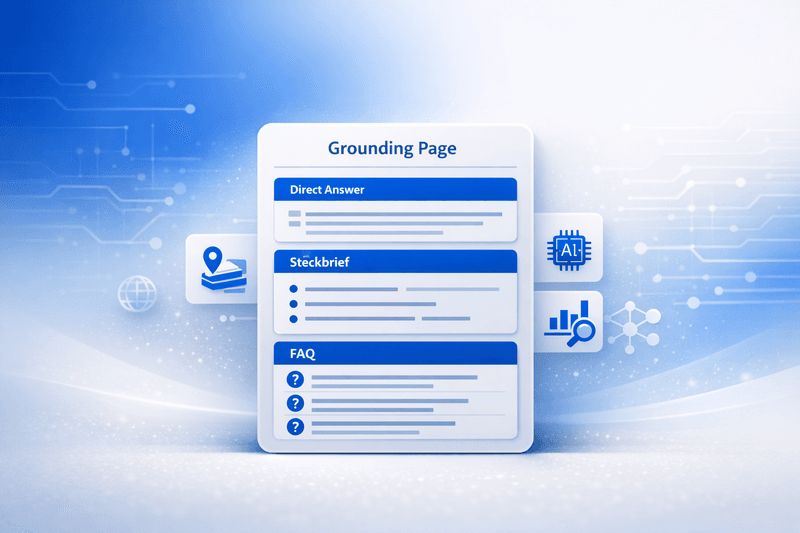
Here's a proven layout that combines GEO, AEO, and B2B readability:
1. Direct Answer / Short Definition (top of page)
Answer the central question briefly and clearly, for example:
"What does [YOUR COMPANY] do?"
- 2-3 sentences, clear, no buzzwords
- Use the terms your buyers actually search with (e.g., "B2B AI marketing platform")
2. Profile Block (Key Facts)
In a table or bullet points:
- Name, legal form
- Year founded, locations
- Target customers (e.g., B2B SMBs in the DACH region)
- Core services (e.g., AI marketing, content marketing, SEO & GEO)
- Price range / contract models
3. Detailed Description
Briefly explain:
- What you do (problem -> solution -> outcome)
- Industries you serve
- What differentiates you from alternatives
4. Authority & Credibility
- Reference customers, success stories
- Certifications, awards
- Partnerships
Studies show that AI answers disproportionately cite pages with clear signs of expertise; around 75% of Google AI Overview sources are top-12 SEO results
Takeaway: Your Grounding Page must be both SEO-capable and professionally credible.
5. FAQ Section (AEO-optimized)
Include 4-8 typical questions with concise answers:
- What does X cost?
- Who is X for?
- How is X different from Y?
Design the answer blocks so they work well for answer engines.
6. Structured Data & Technical Setup
- Schema.org markup (
Organization,Product,Service,FAQPage) - Clean URL structure (
/facts/company-x/or similar) - Canonical tags where duplicates may occur
Tip: Write for humans first. Then mark the sections that can stand alone as answer blocks for AEO. Only then add your schema markup.
Step 5: How to Implement Grounding Pages in Practice
Step 5.1: Collect and Align Your Facts
- Consolidate all facts from pitch decks, website, brochures, etc.
- Validate them with management
- Create a "single source of truth" (your Grounding document)
Step 5.2: Create the Page (CMS or AI Marketing Portal)
- Create a new page (e.g., "/facts/[brand]/")
- Apply the structure from Step 4
- Add internal links (e.g., link product pages to the company Grounding Page)
With an AI marketing platform like Nukipa, the platform handles many of these steps: AI agents structure pages directly from your data - including your brand voice.
Step 5.3: Structured Data & Technical Setup
- Add the relevant Schema.org markup
- Additionally, use
llms.txt- but not as a substitute for robust Grounding Pages
SEO and GEO experts view clearly structured content and schema markup as much closer to the Grounding Page concept than helper files like llms.txt, which are more indicative than foundational
- Make sure the pages are crawlable (no noindex tags, clean robots.txt).
Common mistake: Building Grounding Pages like landing pages - lots of brand messaging, few hard facts. For AI, numbers and clear definitions matter more than ad copy.
Step 6: Integrate Grounding Pages with GEO & AEO
Grounding Pages are part of your ongoing GEO/AEO program.
6.1 GEO Levers for Grounding Pages
- Focus on one entity per page
- Use the phrases people actually start AI searches with (e.g., "B2B AI marketing platform," "AI search optimization")
- Assign pages to topic clusters with internal linking
GEO research shows that a page's structure and semantic clarity significantly increase the chances of being cited in generative AI answers
6.2 AEO Requirements
- Answer blocks in clear, natural language
- FAQ sections with precise headings and lists
- Consistent use of structured data (
FAQPage,HowTo,QAPage)
6.3 Monitoring & Iteration with AI Prompt Tracking
No optimization without measurement.
Platforms like Nukipa monitor how AI models (Google, ChatGPT, Claude) respond to 100+ company-relevant prompts and use this data to automatically optimize content
Test regularly:
- "Who is [YOUR COMPANY]?"
- "What does [YOUR PRODUCT] do?"
- "Which providers exist for [YOUR USE CASE]?"
If you don't appear or are misrepresented, it's time to refine your Grounding Page.
Step 7: Grounding Pages as the Foundation of Your AI Marketing Portal
You now know how to structure individual Grounding Pages. The next step is to embed them as part of your AI Marketing Portal.
Within the Nukipa AI Marketing Portal, three layers come together:
- Content marketing & B2B SEO - blog articles, landing pages, social posts, automated and SEO/GEO-optimized
- Grounding layer - fact pages for companies, products, technologies, industries
- Monitoring & automation - AI prompt tracking, traffic analysis, ongoing optimization based on real AI questions
With Nukipa Pro, B2B companies publish up to 50 blog posts and 60 social posts per month in up to 8 languages - starting at €490 per month
This gives you a combination of scale (large content volume), precision (Grounding Pages), and data feedback from AI searches - a clear advantage for marketing teams with limited resources.
Takeaway: A single Grounding Page is helpful. A structured network of Grounding Pages in an AI Marketing Portal gives you a competitive edge - especially in B2B niches where few are thinking in terms of GEO and AEO yet.
For deeper insights, check out the article "Why Every B2B Company Will Need an AI Marketing Portal by 2026" on content.nukipa.com.
Next Steps: 30-Day Plan
To make this tangible, here's a compact 30-day plan:
- Week 1:
- Create your entity list (company, products, technologies)
- Collect and harmonize your facts
- Week 2:
- Write and publish your first company Grounding Page
- Add schema markup and FAQs
- Week 3:
- Create 2-3 product- or solution-specific Grounding Pages
- Set up internal links
- Week 4:
- Run your first GEO/AEO tests in ChatGPT, Perplexity & others
- Document the results and refine your content
If you want to save effort, explore how Nukipa as an AI marketing platform for B2B handles exactly this - from planning to publishing in the Nukipa AI Marketing Portal. You can find more on the product page Nukipa - KI-Marketing-Automatisierung.
Want to know right away how much output you get for which budget? Take a look at Prices & Plans.
FAQ: Grounding Pages for B2B - The Most Important Questions
Are Grounding Pages only for large brands?
No.
The Grounding Page standard shows examples from a wide range of industries and company sizes; as of January 2026, market overviews list more than 40 Grounding Pages in use - many of them at specialized SMBs
In niche markets, SMBs can quickly establish themselves as the "go-to entity" with fact-based pages.
How many Grounding Pages does my company need?
As a starting rule of thumb:
- 1 × company Grounding Page
- 2-5 × product or solution Grounding Pages
- Optional: 1-3 technology or industry Grounding Pages
Demand (search volume, AI prompts, sales feedback) will determine which additional entities deserve their own Grounding Page.
How do Grounding Pages differ from classic landing pages?
Landing page:
- Goal: conversion
- Tone: emotional, sales-driven
- Structure: benefit-first, objections, social proof, CTA
Grounding Page:
- Goal: factual clarity & machine-readable authority
- Tone: objective, precise
- Structure: definition, profile, facts, FAQ, structured data
Ideally, they complement each other: the Grounding Page provides the facts foundation, the landing page converts.
Do I absolutely need an AI Marketing Portal?
Technically, you can also build Grounding Pages on your main website.
In practice, many B2B sites are slow to change, hard to adapt, and rarely GEO/AEO-optimized. An AI Marketing Portal like Nukipa provides an optimized infrastructure that keeps pace with the evolution of AI search - without you having to rebuild your main site.
How do you know if Grounding Pages are working?
Watch three levels:
- SEO KPIs - rankings, organic traffic
- AI visibility - do you appear in answers from ChatGPT, Perplexity, Google AI Overviews?
- Business impact - qualified inquiries ("We found you via ChatGPT")
With an AI Marketing Portal like Nukipa, you can systematically track all of this - from prompts to content performance.
If you establish Grounding Pages as a fixed part of your AI Marketing Portal, you secure the visibility of your B2B brand - no matter which AI interface dominates in the future.