

If your B2B website is still just a "digital business card," you are losing valuable leads every single day - especially in AI search engines like ChatGPT, Perplexity, or Google Gemini.
In this guide, you will learn:
- why structured content in Markdown is critical for AI search engines and AI agents
- how to systematically convert existing content into Markdown
- how to build headings, lists, tables, and FAQs step by step so they support SEO, GEO, and AEO
- how to connect Markdown content to an AI Marketing Portal so AI agents can reliably find you
By the end, you will have a clear roadmap for making your B2B content marketing ready for AI search optimization - without needing any technical background.
Why Markdown structure matters so much for AI search engines
In brief:
- SEO ensures you appear in Google's search results.
- GEO (Generative Engine Optimization) gets you into the answers of ChatGPT, Gemini, or Perplexity.
- AEO (Answer Engine Optimization) makes sure your content is quoted as a direct answer.
GEO describes how content is specifically prepared for generative AI search systems such as ChatGPT, Gemini, or Perplexity AEO structures content so that answer engines can pull precise answers directly from your content And "AI Search Optimization" brings these strategies together as an extension of classic SEO
Why is this relevant for Markdown?
- Modern AI search systems and RAG frameworks often process content internally as structured Markdown documents.
- Studies like MDKeyChunker and DeepRead show that LLM systems use headers, lists, tables, and paragraphs as natural chunks to deliver better answers.Such systems split documents into semantic chunks along headings, lists, and tables
- The cleaner your Markdown, the easier it is for AI agents to find and quote relevant sections.
Think of your content like a high-performance engine: all the horsepower in the world is wasted if the engine bay is a tangled mess of cables. Markdown structure is the "clean wiring" that lets the mechanics - search engines and AI agents - quickly access the right components of your content.
Prerequisites: What you should clarify before you start
Before you optimize, check these points:
Content foundation:
- You already have blog posts, product pages, or resources available in Markdown - or you can export them from your CMS.
- You know your most important B2B target audiences and their core problems (for example, "Head of Inspection - Energy," "IT Security Manager").
Technical setup:
- Access to the repository or CMS containing your Markdown files (for example, GitHub, headless CMS, static site generator).
- Ideally, content is published via CI/CD, a CMS, or an AI Marketing Portal that handles publishing for you.
Goals & KPIs:
- Clear topic clusters (industries, use cases, products).
- Metrics such as organic traffic, demo requests, and mentions in AI search engines.
With Nukipa, you are one step ahead: the platform handles keyword research, SEO/GEO optimization, and automated publication of your blog posts.Nukipa creates SEO- and GEO-optimized blog posts and publishes them automatically on your blog, including multilingual content You can focus fully on structuring the content itself.
Step 1: Understand how your buyers search today
Before you define your Markdown structure, find out where and how your buyers do their research.
- Around 68% of B2B buyers begin with independent online research before contacting a vendor
- 94% of B2B buyers use search engines like Google during their research
- By 2026, about 67% of B2B buyers will be using AI search tools such as ChatGPT, Perplexity, or Gemini
The takeaway: You need to write simultaneously for SEO (Google) and for AI answer engines (GEO/AEO).
Nukipa sits exactly at this intersection: the platform makes you visible both on Google and within AI search - this is the "new SEO."
Tip: Take 10-20 real questions from sales calls or emails and check how Google, ChatGPT, and Perplexity respond - and whether your company shows up at all.
Step 2: Content inventory in Markdown
Before you optimize, get a clear overview.
Checklist:
- Export relevant pages as Markdown (blog, resources, product pages, documentation).
- Create a table (in Notion, a spreadsheet, etc.) with:
- file name (
b2b-drone-inspection-industrial.md) - main topic/core question
- target persona
- funnel stage (Awareness, Consideration, Decision)
- current structure (H1-H3, lists, tables, FAQ?)
- file name (
- Flag content that already performs well (traffic, leads, AI mentions) and content that has no visibility.
Common mistake: Only creating new content and ignoring older pages. For GEO/AEO this is fatal - AI models primarily rely on existing, well-structured content.
With Nukipa, you can connect this inventory directly to AI prompt tracking data: the platform measures how your content performs across more than 100 AI prompts and uncovers gaps.
Step 3: The ideal base structure for a Markdown page
Here is how a modern B2B Markdown article should be structured for AI search engines.
3.1 H1 - a clear, search-oriented main heading
- Use only one H1 per file.
- Combine problem + audience + outcome, for example:
# Drone inspection for wind farms: How to reduce downtime by 30%# Guide: ISO 27001 certification for SaaS providers in 6 months
Tip: Always phrase the H1 as an answer to "What is this about and for whom?" - not as a flat list of keywords.
3.2 H2/H3 - a logical, shallow hierarchy
A sensible standard structure for B2B articles:
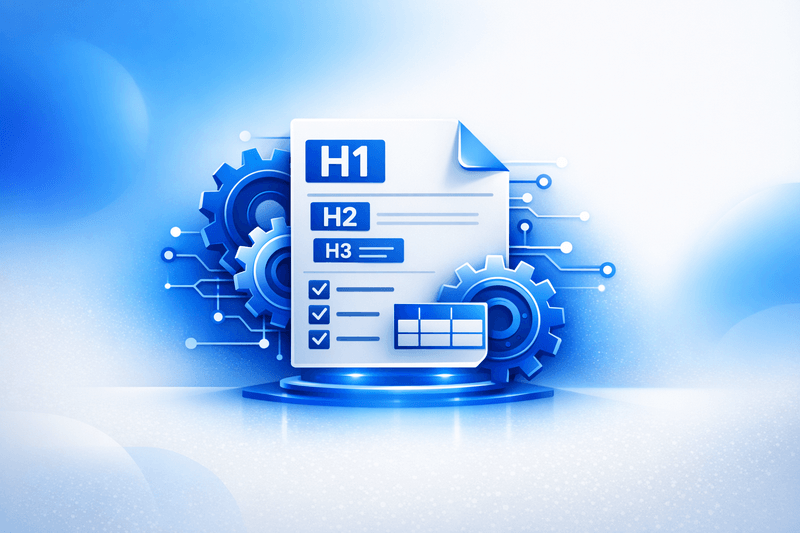
# Main topic (H1)

## Problem & context (H2)

## Target audience & use cases (H2)

## Step-by-step guide / solution (H2)

### Step 1 ... (H3)
### Step 2 ... (H3)

## Examples & case studies (H2)

## FAQ (H2)

### Question 1 ... (H3)
### Question 2 ... (H3)
Why this way?
- SEO: Clear hierarchies help search engines understand topics.
- GEO/AEO: LLM systems slice texts at H2/H3 headings; clean blocks increase the chances that answers are pulled directly from your content.
Common mistake: Skipping heading levels or abusing them for design purposes. For parsers and AI agents, this looks like a broken table of contents.
Step 4: Build content for SEO, GEO, and AEO
Now the content within your Markdown structure becomes crucial.
4.1 One topic, one central question
Each file should answer one clearly defined core question, for example:
- "How do I optimize inspection of my industrial assets using drones?"
- "How do I implement zero-trust security in a mid-sized B2B network?"
State the question explicitly at the beginning and answer it succinctly (5-7 sentences). This significantly improves your chances of being featured in featured snippets and AEO mentions.
4.2 Use lists and tables consistently
AI search engines favor lists and tables because they are easy to extract.
- Use numbered lists for processes.
- Use bulleted lists for benefits, criteria, and checklists.
- Use tables for comparisons (for example, options or feature comparisons).
Example of a comparison table in Markdown:
| Option                | Best suited for              | Main benefit             |
|-----------------------|------------------------------|--------------------------|
| Manual inspection     | Small facilities             | No upfront investment    |
| Drone inspection      | Large, hard-to-access sites  | Less downtime            |
These structures are particularly easy for LLMs to read and reuse in answers.
4.3 Add internal links with semantic meaning
Internal links do more than boost SEO - they help AI systems understand your content as a connected knowledge graph.
- Link to related articles in the body text:
- Good: "Learn more in our guide to AI marketing automation."
- Poor: "More about this here."
- Use descriptive anchor text ("B2B drone inspection in the energy sector") instead of generic terms.
With Nukipa, you can reinforce these connections through automatically planned blog posts and LinkedIn posts. Nukipa - AI Marketing Automation is designed specifically for connected B2B content marketing.
Step 5: Combine Markdown with structured data
Markdown provides the structure, HTML handles presentation, and structured data (Schema.org) gives search and answer engines additional signals.
Google recommends using structured data so that search engines can better understand content and extract information
AI models also read this structured data to produce more accurate answers.
Practical approach:
- Render your Markdown pages to HTML as usual.
- Add structured data to your blog template, such as
Article,BlogPosting, orHowTo. - Mirror titles, headings, FAQs, and author information in the markup.
Tip: For step-by-step guides, use a
HowToschema type. This increases your chances of rich results and clear AI readability.
An AI Marketing Portal such as the Nukipa AI Marketing Portal can handle this technical step for you. That way, your content is optimally accessible for both search engines and AI agents - with structured data embedded behind the scenes.
Step 6: Make Markdown "agent-friendly" for GEO/AEO
With GEO/AEO, you optimize for questions, intent, and dialogues - not just keywords.
6.1 Use questions directly as headings
- Add an FAQ block at the end of every page.
- Phrase H3 headings as full questions:
### How do drone inspections work for offshore wind farms?### What are the benefits of zero-trust security for mid-sized B2B companies?
Answer engines recognize these blocks and prefer to quote them.
6.2 Start with short, unambiguous answers
For every section:
- First paragraph: provide a direct, concise answer (2-4 sentences).
- Then: add details, examples, or analogies.
For AI agents, this first paragraph is usually the most important "answer snippet."
6.3 Consistent terminology
- Use key terms consistently and in the same spelling ("GEO (Generative Engine Optimization)", "AEO (Answer Engine Optimization)", "AI visibility").
- Avoid using multiple different terms for the same concept within a single article.
Mistake to avoid: Empty marketing buzzwords without substance ("disruptive," "next-level"). They do not help readers or AI systems classify your content.
Step 7: Scale quality, consistency, and speed
Structure only pays off if you implement it consistently and at sufficient volume.
- Most B2B buyers now complete more than two-thirds of their research before ever speaking to sales
- You need many well-structured answers to many different questions.
- Doing this manually is almost impossible for small teams.
This is where AI-driven automation like Nukipa comes in:
- With Nukipa Pro you get up to 50 blog posts and 60 social posts per month, starting at €490
- Content is planned, created, SEO- and GEO-optimized, and published directly by AI agents - including multilingual variants.
Define your Markdown conventions (headings, FAQs, tables) and embed them in a platform like Nukipa - this gives you scalable, repeatable structures. You can find more details under Nukipa pricing and plans.
Step 8: Measure what AI search engines do with your Markdown
If you do not measure it, you cannot improve it.
Track:
- In which AI answers you are mentioned (ChatGPT, Gemini, Perplexity)
- Which Markdown pages are cited most frequently
- Which questions remain unanswered
Web analytics alone are not enough. Nukipa goes one step further: more than 100 AI prompts are tested automatically to see where you are visible. These insights flow straight back into your Markdown content roadmap.
Tip: Set up a monthly "GEO review": analyze 10-20 AI answers and ask yourself, "Which of these answers should really have come from us?" This will immediately generate ideas for new articles or improvements.
Common mistakes - and how to fix them in Markdown
1. Too many topics per file
Fix: Split into multiple Markdown files with clear H1 topics, and interlink them.
2. Walls of text with no structure
Fix: Every 200-300 words, add H2/H3 headings, lists, and tables.
3. Headings stuffed with keywords only
Fix: Combine the keyword with a clear statement ("Benefits of drone inspection for wind farm operators").
4. No FAQs
Fix: Add a ## FAQ block with 3-7 questions (as H3) to every core page.
5. Inconsistent style
Fix: Create an internal "Markdown playbook" (levels, lists, tables) and stick to it rigorously.
Why an AI Marketing Portal with optimized Markdown is the logical next step
Even perfectly structured Markdown is not enough on its own. Two challenges remain:
- Technical publishing: Your CMS or website is usually not optimized for AI agents.
- The pace of AI search: GEO/AEO best practices are evolving constantly - your setup has to keep up.
This is exactly what an AI Marketing Portal solves:
- It complements your existing website as a dedicated, AI-optimized content infrastructure.
- Content is published so that it is optimally accessible to AI agents, search engines, and humans.
- The infrastructure (Markdown parsing, schema markup, sitemaps, prompt tracking) is continuously improved - without needing to rebuild your main site.
Nukipa publishes your content on the Nukipa AI Marketing Portal and future-proofs your B2B content for the agentic web - a world where AI agents independently research, compare, and recommend solutions. You will find more strategic insights in our article on AI Marketing Portals.
Next steps: Your 30-day plan
To wrap up, here is a practical 30-day roadmap:
Week 1 - Inventory & rules
- Collect 20-30 existing pages in Markdown.
- Define an internal Markdown playbook (H1-H3, lists, tables, FAQs).
Week 2 - Pilot cluster
- Choose one topic cluster.
- Restructure 5-10 pages in that cluster according to the new rules.
Week 3 - AI review & gap analysis
- Use Google, ChatGPT, and others to check which questions are already covered - and where gaps remain.
- Plan 3-5 new Markdown articles to fill these gaps.
Week 4 - Scale & automate
- Evaluate whether an AI marketing platform like Nukipa makes sense for automation.
- If yes: start a test phase and integrate your Markdown playbook.
If you want to see this in action, get started for free with Nukipa or talk to us about Pro and Managed options. Nukipa - AI Marketing Automation is built for small B2B marketing teams that want to implement GEO/AEO professionally but do not have the resources for manual work.
FAQ
How important is Markdown compared to "regular" HTML for SEO?
Markdown is the authoring format - in the end, the HTML in the browser is what counts. The advantage is that Markdown enforces a clear, consistent structure with headings, lists, and tables. That is the structure that search engines and AI agents process internally. For classic SEO, the HTML is decisive; for GEO/AEO, what matters is how well content can be split into semantic blocks - and Markdown helps enormously with that.
Do I have to move my entire website to Markdown?
No. Focus on the parts in Markdown that deliver knowledge, expertise, and solutions: blog, guides, resources, product how-tos, technical explainers. Corporate information ("About us," careers), contact pages, and similar content can remain in the CMS. The key point: the content that AI agents are most likely to use needs to be cleanly structured.
How quickly will I see results in SEO and AI search if I optimize my Markdown?
That depends on domain authority, competition, and publication frequency. From experience, companies typically see the first measurable improvements in visibility and traffic after 4-8 weeks, assuming they optimize and publish consistently.Most Nukipa customers also see initial success in AI visibility and SEO within 4-8 weeks
Is it enough to simply copy my existing content into Markdown?
Unfortunately not. Just changing the format delivers little benefit if structure and framing are not right. The real impact comes from:
- clear H1/H2/H3 hierarchies
- FAQ blocks with real customer questions
- tables and lists in key places
- meaningful internal links
Markdown is the tool; structure is the real success factor.
How does Nukipa support Markdown-based B2B content in practice?
Nukipa works like an AI marketing team on autopilot:
- The platform understands your positioning, brand voice, and target audience and uses them to develop B2B content in the style you want.
- It creates SEO- and GEO-optimized articles that work extremely well as structured Markdown - with clear headings, lists, and FAQs.
- Content is published on the Nukipa AI Marketing Portal, which is optimized for discoverability by AI agents.
- With AI prompt tracking, you see how your content performs in AI search engines - and can refine your Markdown strategy based on data.
If you take Markdown structure seriously and combine it with an AI Marketing Portal, you build the foundation that ensures AI agents will still be recommending you tomorrow.